Group Intro: Fukushima Network for Denuclearization — Opposing the national policy! History and Today
By Sato Kazuyoshi (Facilitator, Fukushima Network for Denuclearization)
Fifteen years has passed since the Great East Japan Earthquake and Tokyo Electric Power Company (TEPCO) Fukushima Daiichi Nuclear Power Station disaster.
The Fukushima Daiichi NPS disaster stripped the locals entirely of their livelihoods and communities. The Declaration of a Nuclear Emergency Situation issued by the government on March 11, 2011, has not yet been rescinded. The disaster has not ended. Accidents involving station workers’ exposure to radiation are frequent. The exhausting disaster cleanup work is continuing.
History and activities of the Fukushima Network for Denuclearization
The Fukushima Network for Denuclearization is a coalition of groups from across Fukushima Prefecture, which were established by the citizens shocked by the Chernobyl nuclear power plant disaster in 1986. Since 1988, the network has been working in harmony for about 37 years under the slogan of “Prevent NPP accidents! Stop the dangerous NPPs!”
In 1989 a recirculation pump breakdown accident occurred at Unit 3 of TEPCO’s Fukushima Daini NPS and we demanded that TEPCO decommission the reactor. After this accident, we started to have periodical negotiation meetings with TEPCO and issue a monthly newsletter, Network News, both of which still continue today. In 1992, we began to commit ourselves to stopping TEPCO’s plan of adding Units 7 and 8 at Fukushima Daiichi NPS. In 1997, we launched the Stop the Pluthermal Campaign to stop the Pluthermal Program, which loads MOX fuel into light-water reactors. In this campaign we launched a signature collection rally across the prefecture, and in 2002, inviting knowledgeable experts, we held and submitted our proposal to Fukushima Prefecture. After 2005, we were committed to proposing measures against earthquakes and tsunamis, alerting the risks of aging reactors, and promoting investigations into the causes of the accidents and incidents that were frequent at the nuclear power stations.
In 2010, immediately before the end of 40 years of operation of Fukushima Daiichi NPS Unit 1, we established a Hairo Action Fukushima 40-year Planning Committee, hairo meaning reactor decommissioning in Japanese, to study the decommissioning of reactors and portray future local communities thereafter. On March 11, 2011, however, a huge earthquake and tsunamis struck the people and the Fukushima Daiichi NPS exploded due to accumulated hydrogen, generating the worst ever combination disaster of nuclear power accidents and earthquake.
In response to this catastrophic disaster, we announced the establishment of a group named the Complainants for the Criminal Prosecution of the Fukushima Nuclear Disaster in 2012 to pursue charges of criminal responsibility for the Fukushima Daiichi NPS disaster. From around the nation, 14,617 people together lodged a criminal complaint at the Fukushima District Public Prosecutors’ Office. The Office dismissed the case, but the Committee for the Inquest of Prosecution decided twice that prosecution was appropriate: People’s power won the forced prosecution. In 2016, we formed the TEPCO Criminal Trial Supporters’ Group. As 37 proceedings were held at the Tokyo District Court, it was found that, based on the governmental Headquarters for Earthquake Research Promotion’s long-term evaluation of the occurrence of a great earthquake, Tokyo Electric Power Services Co., Ltd. had calculated a possible tsunami height of 15.7 meters and that the TEPCO board of directors had approved the implementing of preparations against the tsunami, but that the three persons accused in this lawsuit had postponed the preparatory measures. Thus it was confirmed that the tsunami had been predicted. In 2019, however, the Tokyo District Court issued an unjust decision that covered up the truth. We proceeded to the appeal trial and further to the final appeal, but in March 2025, the Supreme Court turned down the final appeal submitted by the designated attorney who played the role of the prosecutor. The acquittal of the accused thus became final. This result utterly trampled on the victims and their families as well as all those whose livelihoods and lives were destroyed by the Fukushima Daiichi NPS disaster, which has been the greatest ever environmental hazard. The court decision established a precedent that the operators of nuclear power plants would be exempted from charges. This can lead to another nuclear accident and therefore the decision is completely unacceptable.
15 years after the Fukushima Daiichi NPS disaster
In 2024, about 0.693 g of fuel debris was experimentally retrieved from Fukushima Daiichi NPS Unit 2, and the government and TEPCO announced that this marked the start of the third phase of the Mid-and-Long-Term Roadmap towards the Decommissioning of Fukushima Daiichi NPS Units 1 to 4. However, the Nuclear Damage Compensation and Decommissioning Facilitation Corporation (NDF) announced that the full-scale retrieval of the fuel debris, estimated to be 880 tons in total, would take 12 to 15 years of preparation, and that the start of retrieval work would be in 2037 at the earliest. The roadmap plans to complete the decommissioning in 2051, but it is apparent that the roadmap has already totally collapsed.
What does the word decommissioning mean here? Not only the locals who suffered, but also the entire Japanese population should discuss and reach a consensus through democratic processes concerning whether the buildings will be demolished, how to dispose of the great amounts of radioactive waste, and where to obtain funds to accommodate the costs required for the decommissioning, which is estimated to exceed 23 trillion yen. However, no such consensus-building democratic process is planned, and the government and TEPCO are even waiving a fundamental discussion of what actually refers to decommissioning and how it will be achieved.
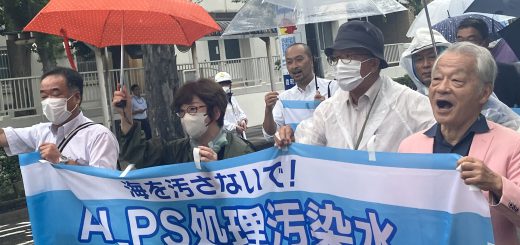
Furthermore, having broken their promise with fishery workers, TEPCO started to discharge ALPS-treated contaminated water to the sea (ALPS stands for Advanced Liquid Processing System). The Fukushima Prefectural Federation of Fisheries Co-operative Associations has been unflinchingly against the discharge, and the ALPS-Treated Contaminated Water Injunction Lawsuit filed by fishery workers and citizens is ongoing. On the other hand, the government is planning to reuse the contaminated soil that was gathered from around Fukushima Prefecture and transported to interim storage facilities for public projects, etc. while there is no prospect for carrying out and disposing of the waste outside the prefecture after 2045, which is the time limit for the use of the interim facilities.
Under such conditions, disaster victims including a great number of people who evacuated around the nation, who stayed in Fukushima, or who once evacuated but returned to Fukushima, are still in agony. The reconstruction of livelihoods of the victims must be understood to mean the recovery of their humanity, which includes within its scope the right of the pursuit of happiness and the right to live in secure dignity as a human being.
Our fight is continuing in various ways, including lawsuits. We, nuclear power disaster victims, will never give up.
(January 14, 2026)