Railroaded through as National Policy?
By Yamaguchi Yukio
It is the New Year. Whatever the situation, Happy New Year!
In any way you look at it, 2025 was an eventful year with many difficulties. Wars have continued in various parts of the world, often with the threat of nuclear war. Long-standing good practices and promises have been discarded without a thought. The Prime Minister of Japan declared a “survival-threatening situation” and there are signs that the “Three Non-Nuclear Principles” are being abandoned. I have the uneasy feeling that dark clouds are converging on the future of humanity.
There is a climate crisis on a global scale and worries that it may be too late to head it off. Signs have been seen of changes in food production—one of the Earth’s blessings. Heat waves, torrential rains, wildfires, rising sea levels and altered ocean currents are thought to be among the many consequences of releasing greenhouse gases.
‘Safety First’ Unachievable
There is a term called “national policy.” Nuclear power plants (NPPs) are said to be “national policy with private management.” Who is it that creates the foundation for national policy? After time shows a national policy to have been mistaken, who takes responsibility for it, and how? I wonder if anyone can “take responsibility” to begin with.
What effective means are there for expressing opposition to national policies? In the past, Japan underwent many years of constant warring. Why were we unable to stop such policies before they got out of hand? It is not as if there were no anti-war movement.
It is nearing on 15 years now since the nuclear accident at Tokyo Electric Power Co.’s (TEPCO’s) Fukushima Daiichi Nuclear Power Station that resulted from the 2011 off the Pacific coast of Tohoku Earthquake on 11 March 2011, yet the nuclear emergency declaration issued that evening has not been lifted to this day. This is because Japan’s government, TEPCO and many citizens, not only in Fukushima Prefecture, but elsewhere, too, recognize that the effects of the accident are still ongoing.
It will take several hundred years for the natural environment of Fukushima Prefecture and its surrounding region to return to its original state. That’s how long it will take for the radioactive cesium-137 that was released in large quantities into the environment to decay. On the International Nuclear and Radiological Event Scale (INES), the accident was given the highest rating of Level 7, a most serious “major accident.” This was because of the large amount of radioactive fallout that resulted across a large region. The inhabitants were left unable to go back and live in the places where they had spent their lives interacting with nature in harmony, to the land where their ancestors had lived with their neighbors and customs. The human rights guaranteed by the Constitution of Japan had come to nothing.
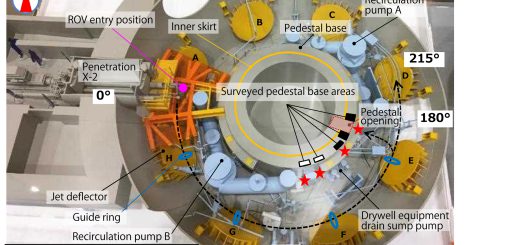
The radioactive contamination of the water from the Fukushima Daiichi plant is deemed “diluted,” and continues to be released into the ocean. The officials have at long last succeeded in the difficult task of retrieving tiny bits of nuclear fuel debris, a mere 0.9 grams in two endeavors, from one of the damaged reactors. They estimate the presence of 880 tons of that debris. Fourteen million cubic meters of contaminated soil have been amassed. Plant workers who are engaged in the endless cleanup work continue to suffer from radiation exposure. Japan’s government and TEPCO say they are “making efforts and taking responsibility until the end” with a goal of 2051 for decommissioning the reactors, but what do they mean by “taking responsibility”?
Elucidation of the accident’s causes is still underway at present. The report from the National Diet of Japan Fukushima Nuclear Accident Independent Investigation Commission (NAIIC) pointed to. “a complicated form of regulatory capture arising as a result of political, governmental, and financial circles uniting toward common goals as national policy” as the root cause of the accident.
Tanaka Mitsuhiko, who served as a member of NAIIC, also became a member of the Niigata Prefectural Technical Committee on Nuclear Power Plant Safety Management (Niigata Technical Committee) and continued communicating with TEPCO, but a number of serious issues remain unresolved. One problem is that radiation levels at the site where the accident occurred make it difficult to conduct on-site investigations, but another major issue has been TEPCO’s reluctance to release information.
Looking at the progress since then, even if a reactor passes the inspections for conformance with the new standards for restarting, Japan’s Nuclear Regulation Authority (NRA) has made it clear to the public that there is no guarantee that it will be safe. Therefore, there is no one who can say that safety is guaranteed. There are many things that no one knows. No matter how much the government and others who want to promote nuclear energy appeal to “safety” as a major premise, there is no way for them actually to achieve it. This cannot be called “taking responsibility” for it.
Kashiwazaki-Kariwa NPS to Restart?
Regarding Niigata Governor Hanazumi’s decision last November 21, when he indicated substantial agreement on resuming operation of the Kashiwazaki-Kariwa Unit 6 reactor under the management of TEPCO, who caused the Fukushima nuclear accident, how does one react? Hanazumi campaigned and was elected in June 2018 with the catchphrases “We aim for a society free from nuclear power. We will not discuss restarts until the three verifications are completed! We will ask the citizens of our prefecture whether restarts are appropriate!” Here, gaining the trust of the prefecture’s citizens had become the major point at issue.
I should explain what the “three verifications” are.
In the summer of 2002, TEPCO was discovered to have concealed, altered and falsified large amounts of data at three of its NPSs, Fukushima Daiichi, Fukushima Daini, and Kashiwazaki-Kariwa, in a cover-up incident of unprecedented scale. With a deep sense of crisis, the then governor of Niigata Prefecture established the Niigata Technical Committee to look into NPS safety and promote deeper discussions to prevent recurrences of such incidents.
In the Chuetsu offshore earthquake in July 2007, there were 3,270 cases of damage of varying degrees that occurred at the Kashiwazaki-Kariwa Nuclear Power Station. In response, Niigata Prefecture created two new subcommittees, one on facility soundness and seismic safety and the other on earthquakes, geology, and the ground, and invited several researchers critical of nuclear power to participate in each subcommittee. This is called “the Niigata Method,” and it is exceedingly rare, unlike government-associated councils with large numbers of members who all follow the government’s policies.
Later, three new verification committees were established by Governor Yoneyama Ryuichi in August 2017. One was a Technical Committee (for verifying the causes of accidents), and the others were a Committee on Health and Livelihoods (for verifying impacts on health and livelihoods) and a Committee on Evacuation (for verifying safe methods of evacuation). To tie them all together, a Verification Review Committee was established in February of the next year.
Governor Hanazumi, however, seems to have considered the Verification Review Committee (chaired by Ikeuchi Satoru) unnecessary, as they met only twice in five years. Its chair was dismissed on March 31, 2023, and the three verification committees were dissolved at the same time. I think this was when Governor Hanazumi initially began paving the way for reactor restarts.
Since then, the Niigata Technical Committee, which had existed prior to that time, has discussed the causes of the Fukushima nuclear accident and identified 22 issues, but there has been disagreement among the committee’s members regarding four of them, and the committee has been unable thus far to reach an agreement on these. It is well known that even to begin with Kashiwazaki-Kariwa NPS was being called a “nuclear power plant on tofu,” and geological and ground problems at the Kashiwazaki-Kariwa site remain sources of instability. The Noto Peninsula earthquake on 1 January 2024 provided a clear demonstration of the difficulty of evacuating in the event of an accident.
We need nukes, they say, because electricity is convenient, because they will reduce the cost of electricity, because the amount of electric power needed for data centers is growing bigger, because power is needed for semiconductor plants, because they do not emit greenhouse gases…because, because. In the name of national policies, one governmental directive is introduced after another. What is needed to meet our responsibilities to future generations is for the current generation to adhere to the “Three Non-Nuclear Principles,” choose renewable energy, stop destroying the global environment, thoroughly refute past irresponsible actions and not repeat further irresponsible actions. We must bear in mind that Japan faces natural hazards from future major earthquakes, tsunamis and volcanic eruptions.