Questioning the Obsolescence of Nuclear Power Plants — Part 4. Lawsuit to Revoke the Permits for Operating Lifetime Extensions for Takahama Units 1 & 2 and Mihama Unit 3: Underestimated Neutron Irradiation Embrittlement of Aging Reactors
By Ino Hiromitsu, Nuclear Power Plant Aging Problem Research Group, Professor Emeritus of the University of Tokyo
Every reactor pressure vessel (RPV) in operation gradually becomes brittle, exposed to neutrons emitted from the core. A brittle material is prone to the generation and growth of flaws (such as cracks and fissures). The strength of a material that is free from any flaw is expressed by tensile strength and yield strength. The resistance of a material to flaws is expressed by critical fracture toughness value KIc (keɪ-wʌn-siː).
Steel material has lower fracture toughness in the low temperature region. Nearly 100 years ago, when the Second World War was going on in January 1943, there was an accident in which the Liberty Ship SS Schenectady, which was moored in Oregon Shipbuilding Corporation, was split into two bodies. The sea waves then were weak, and the impact exerted on the ship body was less than half the yield strength of the material. Although the impact was only very small, the large structure was wrecked due to brittle failure.
If a similar brittle failure occurred with an RPV, it would result in a catastrophic disaster, since the materials that make up the core would spout from the reactor, causing radioactive contamination on a massive scale.
To assess pressurized thermal shocks (PTSs) on the RPV steel whose embrittlement has progressed due to neutron irradiation, Regulatory Code JEAC 4206-2007, established by the Japan Electric Association (JEA), is used. The author explains how neutron irradiation embrittlement is associated with PTS assessment using Fig. 1.
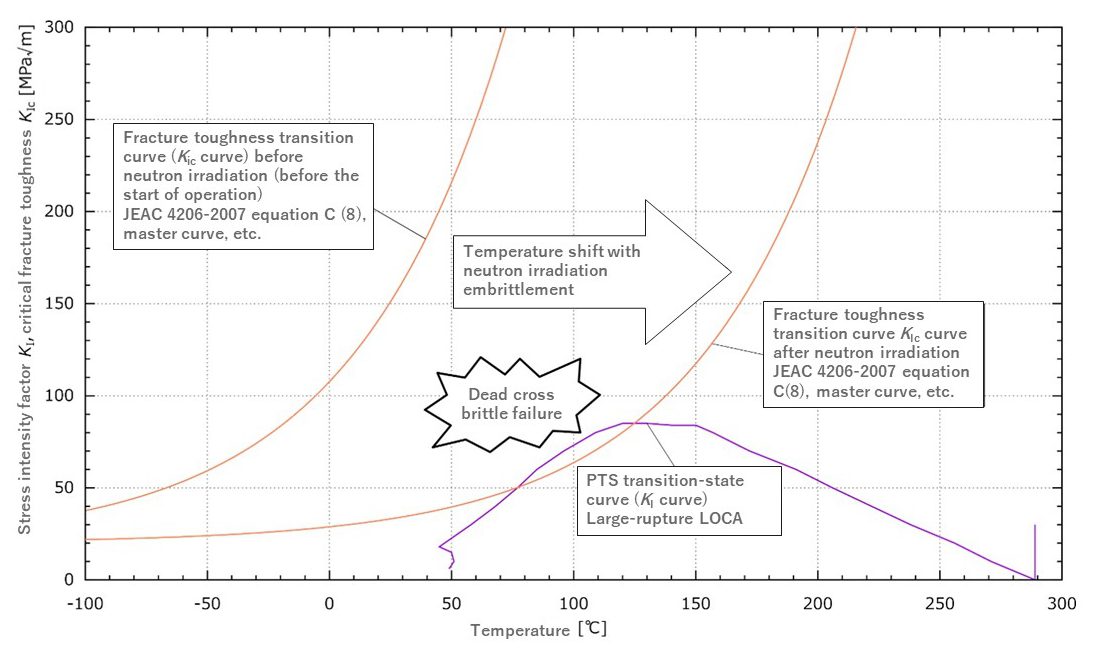
Fig. 1 PTS Assessment (Critical Fracture Toughness Transition Curves and PTS Transition-state Curve)
Fig. 1 shows critical fracture toughness transition curves along with the PTS assessment curve in the case of a large-rupture LOCA (loss of coolant accident). The critical fracture toughness transition curves represent critical fracture toughness values KIc of RPV steel material at different temperatures. The critical fracture toughness is the maximum toughness a flaw can resist.
This KIc curve is expressed by Equation C(8) in Appendix C to JEAC 4206-2007.
KIc = 20.16 + 129.9exp[0.016(T-Tp)] Equation C(8)
Equation C(8) indicates that the critical fracture toughness transition curve of a material shifts toward higher temperatures as the material is irradiated with neutrons.
The mound-shaped curve, the PTS transition-state curve, represents time-based changes in the intensity of stresses exerted on the flaw (stress intensity factor KI) at the time of a loss-of-coolant accident (LOCA) on the assumption that a flaw of a given size (no smaller than the flaw sizes discovered by monitoring tests) exists on the internal surface of the pressure vessel.
It is assessed that a brittle failure occurs when stress intensity factor KI exceeds critical fracture toughness value KIc of the material, namely, when the two curves intersect with each other. In other words, it is a precondition for safe reactor operation that, even if a large-rupture LOCA occurs, the critical fracture toughness transition curve (KIc curve) does not come into contact with the PTS transition-state curve (KI curve). Character KIc means the critical values of KI.
Insufficient temperature-based shift estimation — prediction leaving room for risks
In the reactor pressure vessel (RPV), capsules are provided at a location closer to the reactor core than the internal surface of the RPV, and test specimens of the same steel material as the vessel are stored in them. The specimens are retrieved from the capsules and tested for monitoring. The reasoning of this capsule placement is that, because the specimens are exposed to more neutrons than the internal surface of the RPV, the brittleness of the vessel material can be foreseen.
The toughness transition curves in Fig. 1 are associated with measurement data obtained in this way (while they are not shown in the figure). The curves are drawn so as to encompass all the data, namely, to determine the lower bound of the curve by enveloping the data.
The critical fracture toughness values shown in this figure are obtained by estimating the fluence of neutrons irradiating the pressure vessel during the extendable reactor service period specified in JEAC 4206-2007 and by shifting the critical fracture toughness values according to temperature rises up to the end of the extended reactor lifetime period.
This figure enables the determination of critical fracture toughness values of the specimens under different temperatures. The critical fracture toughness value refers to the maximum damage (toughness deterioration) after neutron irradiation.
On the other hand, it is stipulated that the critical fracture toughness transition curve at 60 years after the start of operation is predicted by shifting the critical fracture toughness values by the amount of transition of the brittle transition temperature (more specifically, the reference temperature) (ΔRTNDT). The amount of transition is stipulated to be obtained based on all the monitoring test data in accordance with the neutron fluences. It is stipulated that the temperature shift ΔTKIc of critical fracture toughness is calculated by equation C(12) of Appendix C in JEAC 4206-2007. The equation is shown below:
ΔTKIc = The calculated value of ΔRTNDT (at the time of assessment) – the calculated value of ΔRTNDT (at the time of each monitoring test) + σΔ Equation C(12)
where, σΔ is the standard deviation of error.
This equation is highly problematic. The entire JEAC 4206-2007 regulations are prepared based on this equation. Therefore, if the JEAC 4206-2007 regulations are correct, the equation below must be true.
Critical fracture toughness temperature shift amount ΔTKIc
= Brittle transition temperature shift ΔRTNDT
New discoveries
On July 27, 2023, the 60th Technical Information Review meeting of the Nuclear Regulation Authority was held, where a report entitled “Review of Critical Fracture Toughness Based on the Data of Actual Plants”1) was presented. In this report, a fact that clearly denies the equation ΔTKIc = ΔRTNDT was presented (Fig. 2 below).
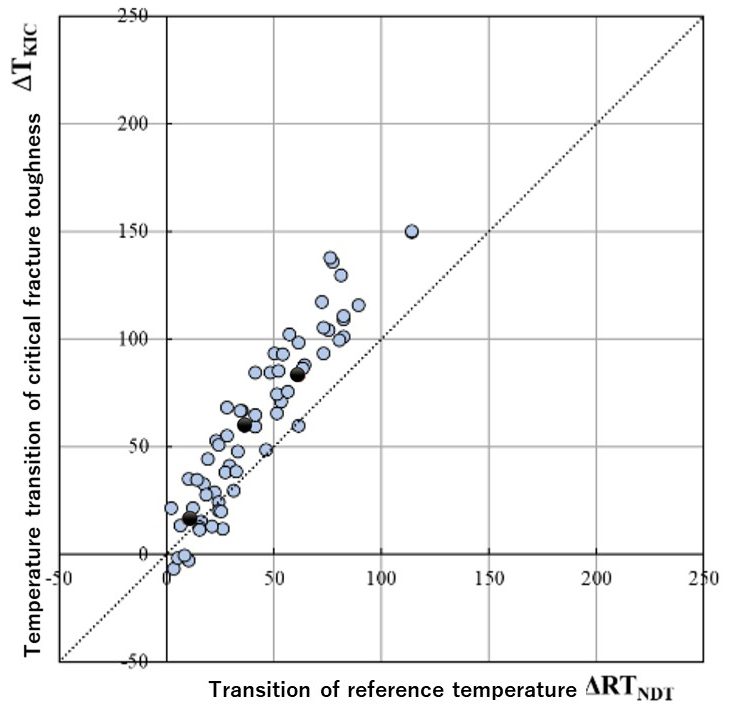
Fig. 2 Relationship between Temperature Transition of Critical Fracture Toughness ΔTKIc and Temperature Transition of Brittle Transition Temperature ΔRTNDT of actual PWRs in Japan (Actual Measurements)
In the report presented at the meeting by the NRA Secretariat, the temperature shift of critical fracture toughness temperature ΔTKIc and temperature shift of brittle transition temperature ΔRTNDT are calculated by the following process.
(1) At each monitoring test on the individual plants, data on the material type, reference temperature, critical fracture toughness, and test temperature are prepared.
As an example, to obtain the critical fracture toughness curve (KIc curve) of Takahama Unit 1, the critical fracture toughness values obtained by the first to fifth monitoring tests of Takahama Unit 1 are plotted on the diagram and the critical fracture toughness transition curve is drawn as per equation C(8).
(2) For each critical fracture toughness value, Tp is calculated by equation C(8) in JEAC 4206-2007 Appendix C.
(3) For each monitoring test, the average value of Tp is calculated.
(4) The difference ΔTp between the average value of Tp of each monitoring test and value Tp before neutron irradiation is used as ΔTKIc.
(5) The difference between RTNDT at each monitoring test and RTNDT before neutron irradiation is used as ΔRTNDT.
Fig. 2 in this article is a reproduction of Fig. 6 in the NRA Secretariat report.
Discussion
This “Review Concerning Critical Fracture Toughness Based on the Data of Actual Plants”1) presented by the NRA Secretariat in July 2023 made it clear that, concerning pressurized-water reactors (PWRs) in Japan, rises ΔRTNDT in brittle transition temperature due to neutron irradiation and rises ΔTKIc in critical fracture toughness due to neutral irradiation are not equivalent. Further, researchers, including this author, conducted statistical data analysis and estimated that, in the case of the base material, ΔTKIc is 32% greater than ΔRTNDT, and in the case of weld metal, ΔTKIc is more than 44% greater.
Our readership will wonder why such differences occur while both brittle transition temperature and critical fracture toughness are the results of observation of the same brittle failure phenomena.
The reason is still unknown, but the study conducted by Wallin et al.2) is noteworthy. According to the results of their study, the difference comes from the difference in the deformation rate used for the specimens. The results of their study indicate that, in the Charpy test and dynamic fracture toughness test, both of which show a high deformation rate, the amount of shift due to irradiation is smaller when compared with the static fracture toughness test. The study concludes that using the Charpy test in place of the static fracture toughness test is risky.
The JEAC 4201 and JEAC 4206, which were prepared by JEA and endorsed by the regulating authority, have many other errors and deficiencies in addition to the problem concerning the equivalence in the temperature shifts. As an example, two terms in the reaction rate equation, from which the prediction equation is derived, are inconsistent in dimension (one term including the first power of the diffusion coefficient and another term including the second power of diffusion coefficient are summed).3) The revision of these codes was requested by the NRA more than 10 years ago, but JEA has not completed the revision. Does JEA have some difficult circumstance that is preventing them from correcting these errors?
Private standards are prepared by operators. Therefore, citizens must strictly monitor them. The attitude of JEA to the request is extremely backward-looking, while the regulating authority’s response is merely lukewarm.
Conclusion
(1) Based on the data of plants in Japan, a highly reliable, new relationship between the temperature shift ΔTKIc of fracture toughness and the temperature shift ΔRTNDT of brittle transition temperature has been derived. The relationship between the two is expressed as ΔTKIc = aΔRTNDT, in which a = 1.32 in the case of base material, and a = 1.44 in the case of weld metal.
(2) A PTS assessment was conducted for Takahama Unit 1 based on this relationship, and it was found that operating the unit for more than 60 years is highly risky.
(3) The pressure vessel safety evaluation codes created by JEA, JEAC 4201-2007 and JEAC 4206-2007 need to be revised to comply with the correct temperature shifts. The superannuated nuclear power reactors across the nation must be retested for safety based on the revised codes.
(4) This article has mainly discussed the problem of the temperature shift in reference to JEAC 4201-2007 and JEAC 4207-2007, but these codes have other errors and deficiencies as well, such as the inconsistent dimensions of the terms of the reaction rate equation (one term including the first power of the diffusion coefficient and another term including the second power of the diffusion coefficient are summed).
The author wrote this article based on the paper coauthored by Associate Prof. Aono Yuuta of the National Institute of Technology, Kurume College and the author, “The Risks of Aging Reactors — Underestimation of Neutron Irradiation Embrittlement.”4)
References
1) NRA Secretariat, “Review of Fracture Toughness Based on the Data of Actual Plants” (in Japanese), the 60th NRA Technical Information Review Committee (2023).
2) Wallin, K. et al., “Descriptive Characteristics of Different Types of Test for Irradiation Embrittlement,” Nuclear Engineering and Design, vol. 159, pp. 69–80 (1995).
3) Plaintiffs’ Brief (97), “Neutron Irradiation Embrittlement: Counterarguments and Additional Assertion Based on Expert Opinions,” in the Lawsuit to Revoke the Permits for Operating Lifetime Extensions for Takahama Units 1 & 2 (Lawsuit to Decommission Aging Nuclear Reactors at 40 Years in Nagoya) (2023).
4) Aono Yuuta and Ino Hiromitsu: “The Risks of Aging Reactors” (in Japanese), Kinzoku: Materials Science and Technology, Vol. 94, No. 9 (2024).
Notes
Using the actual plant data of Genkai Unit 1 and Mihama Units 1 and 2, the author performed an analysis and repeatedly argued at the Advisory Committee on the Technological Assessment of Aging in Nuclear Reactors of the Nuclear and Industrial Safety Agency in 2012 that assumption ΔTKIc = ΔRTNDT did not hold true.
At that time, the author gained the cooperation of Prof. Okamura Hiroyuki, emeritus professor of the University of Tokyo, who is a great authority of fracture mechanics, and conducted an analysis using fracture toughness observations to obtain the critical fracture toughness curve of Genkai Unit 1. The results indicated that the critical fracture toughness curve was higher in temperature than the curve obtained according to the JEAC 4206-2007 codes.
The analysis by Prof. Okamura was written in a private communication addressed to the author (March 2, 2012) but was not disclosed due to the wishes of Prof. Okamura. It was disclosed at the Lawsuit to Decommission Aging Nuclear Reactors at 40 Years filed with the Nagoya District Court, in which Prof. Okamura presented the above analysis and stated concerning the attitude of the operator and regulating authority, “Regarding the correlation between ΔRTNDT and ΔTKIc, it would be difficult to predict irradiation brittleness without an examination using the data of actual plants. It is exceedingly difficult to understand why only ΔRTNDT was examined.” This shows Prof. Okamura’s farsighted wisdom.
My impression of the four articles in this series
Part 3, Prof. Takashima Takeo’s article, is related to the mound-shaped curve of Fig. 1. I hope that it will be read in addition to this article. For the judicial issues and perspectives of the appeal trial at the Nagoya High Court, please refer to Part 2, the article by Plaintiff Attorney Mr. Kojima Hiroshi. Part 1, the article by Ms. Shibayama Yasuko (The Group of Citizens’ Seeking a Court Decision Ordering the Decommissioning of Nuclear Plants Over 40 Years Old) discusses the entire scope of the lawsuit to revoke the permits for operating lifetime extensions at the Nagoya District Court. It was to my surprise that there is such a citizen activist who accurately understands the points of the technical issues. I appreciate the many impressive studies and beneficial proposals she has conducted in the procedure of the lawsuit.