Questioning the Obsolescence of Nuclear Power Plants — Part 2. Lawsuit to Revoke the Permits for Operating Lifetime Extensions for Takahama Units 1 & 2 and Mihama Unit 3: Problems of the Nagoya District Court verdict that did not face up to the risks of superannuated reactors
By Kojima Hiroshi (Plaintiff Attorney)
Nagoya District Court verdict
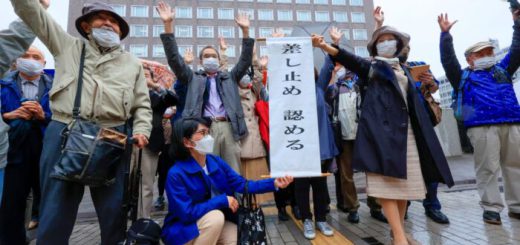
On April 14, 2016, a lawsuit to decommission aging nuclear plants at 40 years was filed with the Nagoya District Court to prevent Kansai Electric Power Company (Kanden) from obtaining a permit to extend the life-spans of Takahama Nuclear Power Station (NPS) units 1 and 2. (After the permit was issued, the claim of the lawsuit was changed to the revocation of the permit, and later the claim was expanded to pursue the revocation of the life-span extension permit for Mihama NPS Unit 3.) On March 14, 2025, about nine years after the filing, Civil Case Section 9 (a special section for administrative lawsuits) of Nagoya District Court rendered a verdict, which unjustifiably turned down the claims of the plaintiffs. (Some of the plaintiffs were judged unqualified and their claims were turned down for that reason.)
Kanden’s Takahama NPS Units 1 and 2 as well as Mihama NPS Unit 3 are the oldest operating nuclear reactors in Japan.
Based on the lessons learned from the disaster of Fukushima Daiichi Nuclear Power Station (FDNPS), the government made a significant administrative change, which is to limit the life-span of a reactor to 40 years as a rule and to approve a 20-year extension in exceptional cases.
The plaintiffs pleaded in court that, in addition to the fact that NPSs are innately dangerous, the aging of the reactors doubles the risks, and that the current administrative assessment of NPSs does not sufficiently assess their aging and therefore does not ensure their safety for the extended life-spans.
However, the court agreed to the allegations of the national government, the defendant, without due deliberation, and concluded that the assessment of the aging NPSs by the Nuclear Regulation Authority (NRA) poses no problems.
Outlines of the verdict for individual points of contention
In terms of the judicial review, the verdict supported the administrative decisions without careful consideration and confirmed that those decisions were deemed legitimate, while stating that the defendant was responsible for proof of the rationality of the specific evaluation standards used in the assessment of compliance with the new regulatory standards and of the judgments of compliance made based on the specific evaluation standards. After the FDNPS disaster, nuclear-related laws and regulations were altered to improve safety and to oblige the administration to perform strict assessments, but we cannot but say that the judiciary has already forgotten the disaster and clearly revealed its attitude of blind obedience to the administration.
I will detail the problems of aging reactors later, but the verdict only discussed the points of contention of the reactors separately and did not mention their risks from the overall perspectives that the plaintiffs had emphasized, such as comprehensive risks of aging reactors and obscurity of reactor models, even in the section explaining the reasons for the verdict. We consider that this lack of discussion from overall perspectives is a huge problem that cannot be overlooked.
Concerning the assessment of reactor pressure vessel (PRV) embrittlement degradation resulting from neutron irradiation, the judges basically consented to the allegations of the defendant, concluding that the current regulatory standards are reasonable and on the conservative (“safe”) side in various respects, and that the processes of the assessments and decisions by the defendant contained no errors or omissions that required closer examination.
For the other problems such as those of power cables, the court decision entirely consented to the government’s allegations.
Regarding the assessment of seismic motion, the verdict acknowledged that the shortest distance between the Shiraki–Nyu Fault and the entire Mihama Unit 3 premises was 600 meters, the seismic center being extremely close to the premises, but the court judged, based on reasoning subsequently added by the defendant, that this would not constitute a case where the seismic center is extremely close to the premises. This judgment should be deemed an apparent mistake, considering that the NRA itself mentioned that 1 km to 2 km as a typical extremely close distance.
Further, in the assessment concerning volcanoes, the NRA acknowledged that when and how great an eruption may occur is not predictable under current volcanology; however, standing on the assumption that it is sufficient to implement known measures and perform what can be done, the NRA stated that the greatest ever scale eruption of Mount Daisen (the Daisen-Kurayoshi eruption) does not need to be considered. Did the court fail to remember the fact that the FDNPS disaster occurred as a result of only doing what could be done?
The verdict also stated that, while the 2019 version of the NRA Guide for Volcanic Hazard Assessment for Nuclear Power Stations seemed to have been revised to be less conservative than its 2013 version, the change was not less conservative according to its subsequently added Basic Policy. If such a verdict were acceptable, it would result in the acceptance of de-facto rule changes based on excuses fabricated later. This verdict is highly problematic in this respect.
Detailed arguments on neutron irradiation embrittlement and pressurized thermal shock (PTS) in the brief on appeal
In the following section, I introduce a part of the appeal brief concerning the point of contention regarding reactor vessel (RV) embrittlement resulting from neutron irradiation (the RV steel becomes brittle after exposure to neutron irradiation over many years), referring to the injustice of the Nagoya District Court verdict.
The point of contention is whether the RV, which becomes brittle when exposed to neutron irradiation, can resist PTS (pressurized thermal shock, which applies strong tensile stresses due to temperature differences between the inside and outside of the reactor at the time of the activation of the emergency core cooling system (ECCS) as a result of the rupture of piping, etc. and causes the RV to contract because of the sudden cooling by water), but this article omits the details of the PTS mechanism.
▶ Framework of judicial judgment concerning the approval of reactors’ life-span extension
In the appeal brief, we have reemphasized and argued the comprehensive points of contention in reactor aging, to which the Nagoya District Court paid very little attention in the verdict. Specifically, we repeated the overall dangers and risks of aging reactors, especially the obsolescence of reactor models and difficulties in degradation control. We also articulated the process of how the 40-year rule was established.
What we attached special weight to in the appeal brief was that the system of reactor life-span extension approval not only assesses the conditions and risks of the reactors as of the present day but also predicts the future conditions and risks of the reactors 20 years further into the future, for which the life-spans are to be extended based on the current degradation conditions. As a result, the life-span extension approval can assess only extremely uncertain matters.
From this point of view, we argued that it is critical to assess safety in consideration of those uncertain matters more carefully than when an installation (change) approval is assessed for newer reactors.
The attorney team discussed this point of contention repeatedly. The safety level required of aging reactors is the same as that required of newer reactors; aging reactors and newer reactors are reviewed according to the same judgmental framework.
Nevertheless, it is generally understood that aging reactors are more likely to experience a severe accident than newer reactors, notwithstanding the matters that have been discussed so far; we emphasized that, to determine whether aging reactors are actually safe or not, it is essential to judge each single aging reactor specifically, based on their characteristics and the specialties of their life-span extension approval system.
In the appeal brief, we once again emphasized the points of contention based on the views of Prof. Shimoyama Kenji. We argue that the following viewpoints should be considered when the governmental decisions are judged to be not unreasonable and free from errors and/or omissions when there is scientific indefiniteness (uncertainties):
1) All the reliable data and information available at the time are examined.
2) Confirmation that the adopted research, analysis and prediction methods are appropriate and reliable.
3) All the relevant rights and legally protected interests are compared and weighed with reference to legal systems and intentions.
4) The processes involved in the decisions and judgments of the above are clearly described along with the reasons for the decisions made.
5) There is no arbitrariness and/or unreasonable impetus in the entire decision making process.
6) The responsibilities for any subsequent revision or modification of the original decisions, where necessary, are fully exercised.
We argued that the defendant should confirm that each of these conditions is satisfied, and that if any of them is not satisfied, the administrative agency’s judgment presumably contains an error or omission.
Judicial judgments should essentially be made from such a meticulous and analytical perspective.
▶ Failure in the execution of “assessment using a method that estimates future irradiation embrittlement on the conservative side” based on the Guide for the Rules of Commercial Nuclear Power Reactors Concerning the Installation, Operation, Etc.
The appeal includes several arguments regarding the issue of RV embrittlement due to neutron irradiation. We would like to present the arguments related to the assessment of future irradiation embrittlement.
The excerpt of the appeal brief argues:
Concerning an application for the extension of a reactor life-span, Article 113, Paragraph 2, Item 2 of the Rules for Commercial Nuclear Power Reactors Concerning the Installation, Operation, Etc. demands the submission of “documents detailing technical evaluation results.”
The Guide for the Rules of Commercial Nuclear Power Reactors Concerning the Installation, Operation, Etc. (Plaintiffs’ Document B76) specifies as written below, concerning the “documentation containing technical assessment results regarding the degradation conditions of the reactor and other equipment arising from operation during the life-span extension being sought” in Article 113, Paragraph 2, Item 2 of Section 3.2, Rules for Commercial Nuclear Power Reactors Concerning the Installation, Operation, Etc. (underlines by the appellants, including attorneys).
(1) . . . the test items that shall be assessed and whose results shall be described when, in particular, a life-span extension is applied for, are as listed below:
1) Degradation condition assessment based on the results of the special inspection specified in Section 3.1 above.
2) The test results of the monitoring specimens removed as recently as possible within the 10 years following the date marking 30 years of service after the start of operation. (The timing for removing the monitoring specimens shall be the time of the periodical inspection by the operator that is conducted closest to the submission deadline for the application as specified in Chapter 1 [excluding, as a rule, the time of an inspection due to an unplanned reactor outage], in consideration of the period required for specimen testing, etc. [approximately three years]).
3) Regarding pressurized water reactors, the following matters in the integrity assessment, etc., based on the test results described in Paragraph 2) above:
-
(skip)
-
An assessment based on actual measurement data without future irradiation embrittlement prediction and an assessment using a method capable of conservatively predicting future irradiation embrittlement.
-
Pressurized thermal shock (PTS) assessment using fracture toughness values at a depth of 10 millimeters from the inner surface in the proximity of the RV core.
As described above, the second bulleted item of Paragraph 3) in the Guide for the Rules of Commercial Nuclear Power Reactors Concerning the Installation, Operation, Etc., demands not only an assessment of integrity at the time of the assessment based on actual measurement data, but also a separate assessment to ensure conservative predictions for the future (this requirement is referred to as the “conservative prediction requirement.”).
This requirement is deemed reasonable, because even the current embrittlement conditions cannot be accurately measured but can only be estimated, because the predictions of conditions after operation for as long as 20 years are even more difficult to estimate, because the conditions of long-term irradiation of more than 40 years of operation are largely unknown both domestically and internationally, because the NRA is negative about extrapolation as described previously, and because risks are extremely high if reactor integrity cannot be maintained.
As described above, in the approval of reactor life-span extension, it is a common point to consider as a basis of safety assessment that a conservative assessment should be performed in consideration of uncertainty in assessing safety at a future point of time. The “conservative prediction requirement” is deemed to be established especially to consider this perspective in terms of the determination of fracture toughness values.
The appeal brief also argues:
. . . (list of current assessment criteria). . . . As discussed thus far, these criteria are specified as a measure to determine the degree of RV embrittlement at a specific evaluation point of time, but cannot be regarded as an assessment method capable of conservatively estimating irradiation embrittlement specified by the conservative prediction requirement.
(snip)
The original verdict states that having superior fitting characteristics itself ensures conservative future predictions in compliance with the conservative prediction requirement. However, even if superior fitting characteristics are provided and if the provision of superior characteristics can be deemed reasonable based on 2), the technical standard rule, it cannot signify that the future degradation of the reactor and other equipment is predicted on the conservative side for 1), the extended life-span (at the end of the span).
In addition to the argument above, referring to the Osaka District Court’s December 4, 2020 ruling regarding the Ohi Nuclear Power Plant, which judged that the failure in the consideration of data dispersion was illegitimate, we stated that Kanden has not proved in this lawsuit that the operator conducted any separate, independent conservative assessment based on this “conservative prediction requirement” concerning the fracture toughness transition curve with respect to temperature transition in the future, and that the NRA overlooked this lack of proof.
We argue that the error or omission we point out is significant and could result in the oversight of the possibility of critical crossing of the PTS assessment transition curves, and that the NRA review processes had serious errors and omissions.
▶ Points of contention concerning the consideration of cladding
We also argue several points of contention regarding PTS estimation as illegitimate. We would like to introduce a representative point, which is concerned with reactor cladding (stainless steel lining deposit-welded on the internal surface of the reactor container), and which is deemed illegitimate.
The original verdict states in the second paragraph on page 327, “the absence of provisions regarding the cladding in JEAC 4206-2007 does not constitute grounds for concluding that the standards prohibit the consideration of the cladding in thermal conduction analysis, and given the fact that cladding exists on the surface of each RPV in this case, it cannot be deemed unreasonable to consider the cladding in the thermal conduction analysis.” The verdict provides three reasons as the grounds for this judgment.
i In the PTS research report based on which JEAC 4206-2007 was established, cladding is considered in thermal conduction analysis, while in stress analysis, cladding is not considered in the calculation of the PTS transition curve.
ii In the response submitted by the Federation of Electric Power Companies of Japan to the hearing meeting on the technological assessment of reactor aging . . . , it is assumed that the inner surface of the RV is provided with cladding free of fissures and that cooling water will not come into direct contact with the fissured positions of the base metal (D B113), and there is no indication that this was viewed as problematic.
iii The Japan Electric Association that established JEAC 4206-2007 . . . responded that analysis in consideration of cladding is not prohibited, while JEAC 4206-2007 does not specify requirements regarding the cladding.
While refuting these reasons in depth, we consider that the fundamental problem is that Kanden, the intervener in this lawsuit, changed analytical models in the middle of the series of analyses, thereby deliberately lowering the stress intensity factor, instead of performing the analyses on the more conservative side.
The PTS assessment is performed in the order of (1) thermal hydraulic analysis, (2) heat conduction analysis (synonymous with temperature distribution analysis), (3) stress analysis, and (4) stress intensity factor analysis.
In this lawsuit, the issue of the cladding is mainly associated with thermal conduction analysis and stress analysis.
Concerning the PTS assessment, the intervener considered the presence of cladding in the analysis of the RPV’s temperature distribution, while not considering it in the stress analysis and stress intensity factor analysis. Namely, the intervener treated the cladding as stainless steel in thermal conduction, while calculating the stress analysis without regard to the cladding.
However, the PTS assessment represents a series of processes, from the calculation of stress distribution to the determination of stress intensity factor; it is not only associated with temperature distribution analysis. From a technical standpoint, modifying the shape model in the middle of the series of analyses is deemed unreasonable.
As we will discuss in the details later, the intervener performed the thermal conduction analysis by means of the physical properties by which the thermal conductivity would be lower (moderating temperature distribution, reducing thermal stress, and thereby acting to decrease the stress intensity factor), while in stress analysis, the intervener performed the analysis only using the data concerning the base material without regard to the cladding, by which the thermal expansion coefficient would be larger and thus thermal stress would be greater, unreasonably obtaining calculation results that indicate a lower stress intensity factor.
As described above, the fact that Kanden changed the analytical model for the cladding in the middle of the series of analyses, not in order to obtain more conservative results but to decrease the stress intensity factor, is extremely problematic.
The Nagoya District Court verdict sounds as if it is saying: “The cladding is actually there, so it’s fine, isn’t it?” However, the issue is not that simple. The analyses were conducted utilizing material properties that lower the stress intensity factor in the operator’s favor (namely, by “cherry-picking” the data). Such an analytical method can never be acceptable in the assessment of nuclear power plants, in which safety must never be compromised.
Conclusion
Due to space restrictions, this article introduces only a part of the appeal brief concerning neutron irradiation embrittlement. We, the plaintiff attorneys, are determined to fight to have the injustices of the Nagoya District Court verdict heard in the appeal court. We would be very grateful if the public would continue to look closely at this aging reactor lawsuit, not only concerning the issue of the embrittlement but also other points of contention.