Lawsuit to Nullify the Rokkasho Reprocessing Plant’s Business License – Updates: Potential Activity of Continental Shelf Fringe Fault and Rokkasho Fault (2)
By Kamisawa Chihiro
Rokkasho fault as a branch fault of the continental shelf fringe fault
In the previous article in Nuke Info Tokyo No. 233 (August 10, 2026), I explained that the continental shelf fringe fault is active: Compared with the geological interpretation by Dr. Ikeda Yasutaka, former Nara University Professor (of tectonic geomorphology), of the cross-section obtained by acoustic
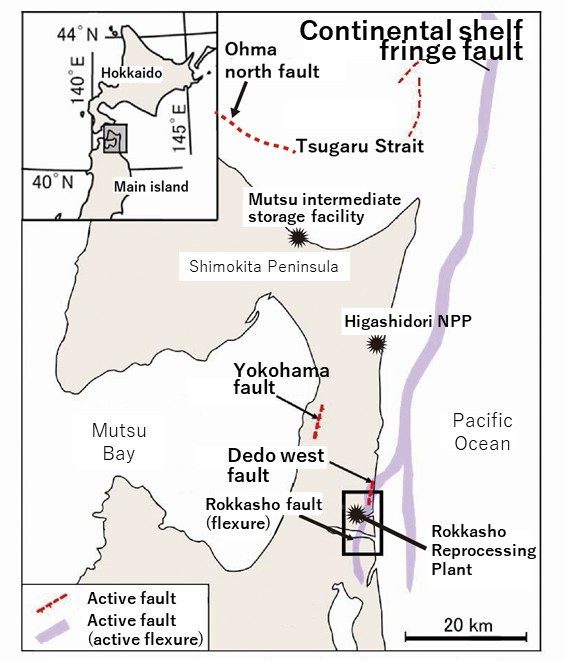
Fig. 1 Active Faults on and near Shimokita Peninsula and Rokkasho Processing Plant (Figure in Watanabe 2016 with Author’s Modification)
reflections, it is clear that the marine boring data used by Japan Nuclear Fuel Limited (JNFL) to justify their reasoning does not provide sufficient scientific basis. In this article, I would like to discuss the potential activity of the Rokkasho fault, based on the claims recently delivered by the complainant at the Aomori District Court.
The Rokkasho fault is a branch fault of the continental shelf fringe fault. As shown in Fig. 1, it branches out from the continental shelf fringe fault and then extends to the south, running below the Detoseiho fault. The tip of the Rokkasho fault does not appear on the ground surface; its existence can be known from the Rokkasho flexure, which was initially a flat surface but is bent today. The Rokkasho flexure extends across the premises of the nuclear fuel cycle facilities, runs through Lake Obuchinuma and further extends to the south through Lake Takahokonuma.
Deformation of the marine terrace surfaces in association with the Rokkasho fault (Rokkasho flexure)
I explained that the Rokkasho fault is active in CNIC Japanese newsletter Tsushin No. 545 (November 1, 2019) and No. 592 (October 1, 2023), based on the results of research by Dr. Watanabe Mitsuhisa, Professor of Toyo University (of tectonic geomorphology). The most critical point is that a marine terrace surface (M1), which was formed 120,000 to 130,000 years ago, appears to bend over an extensive range. The flat surface produced near the coastline 120,000 to 130,000 years ago was upthrusted by many earthquakes caused by the continental shelf fringe fault, and at the same time the surface was bent by the movements of the Rokkasho fault, producing the Rokkasho flexure. The Rokkasho area is composed of these geomorphological and geological structures.
The Rokkasho flexure is mentioned in Geological Map of Japan 1:200,000: Noheji (2nd ed.), issued in 2021 by Geological Survey of Japan, National Institute of Advanced Industrial Science and Technology, in which Dr. Watanabe’s research paper is quoted without modification, and is introduced as a confirmed active flexure (blind).
Research concerning the southern tip of the Detoseiho fault
Of the three active faults, which are the continental shelf fringe fault, Rokkasho fault, and Detoseiho fault, JNFL considers the Detoseiho fault only for earthquake-proof safety.
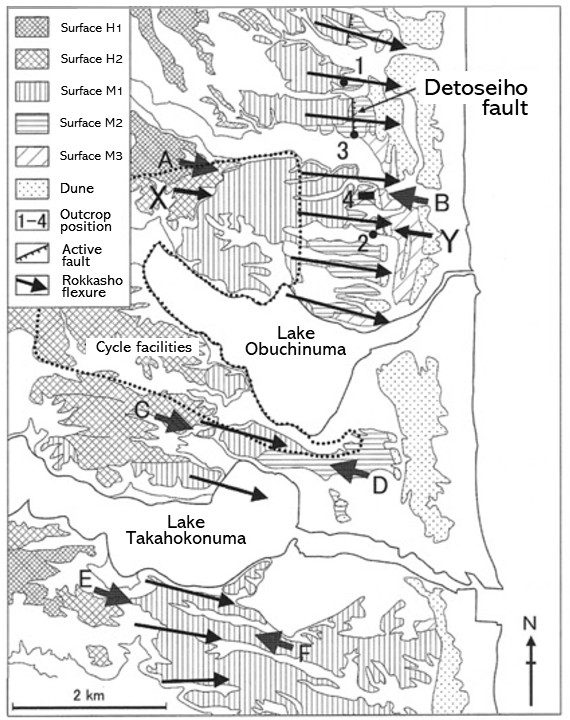
Fig. 2 Geological Formation in the Vicinity of Rokkasho Nuclear Fuel Cycle Facilities and Rokkasho Flexure (Figure in Watanabe Mitsuhisa, 2018)
To determine how far the Detoseiho fault extends to the south, JNFL has conducted boring research, seismic reflection exploration, and trench digging (Fig. 3).
Outcrop D-1 in the illustration on the left in Fig. 3 is valuable because it allows the direct observation of the Detoseiho fault. JNFL conducted boring exploration near Oippegawa River located on the south of outcrop D-1, and concluded that transverse line Z is substantially the southern tip of the Detoseiho fault, stating that the Detoseiho fault was observed at transverse lines X, Y and A but not at line Z. The company observed geological layers at an outcrop (outcrop 4 in Fig. 2) on the southern side of line Z, and conducted trench digging in its vicinity (“Trench off the Southern Tip of the Fault” in Fig. 3), and presented the results to the Nuclear Regulation Authority (NRA) assessment meeting.
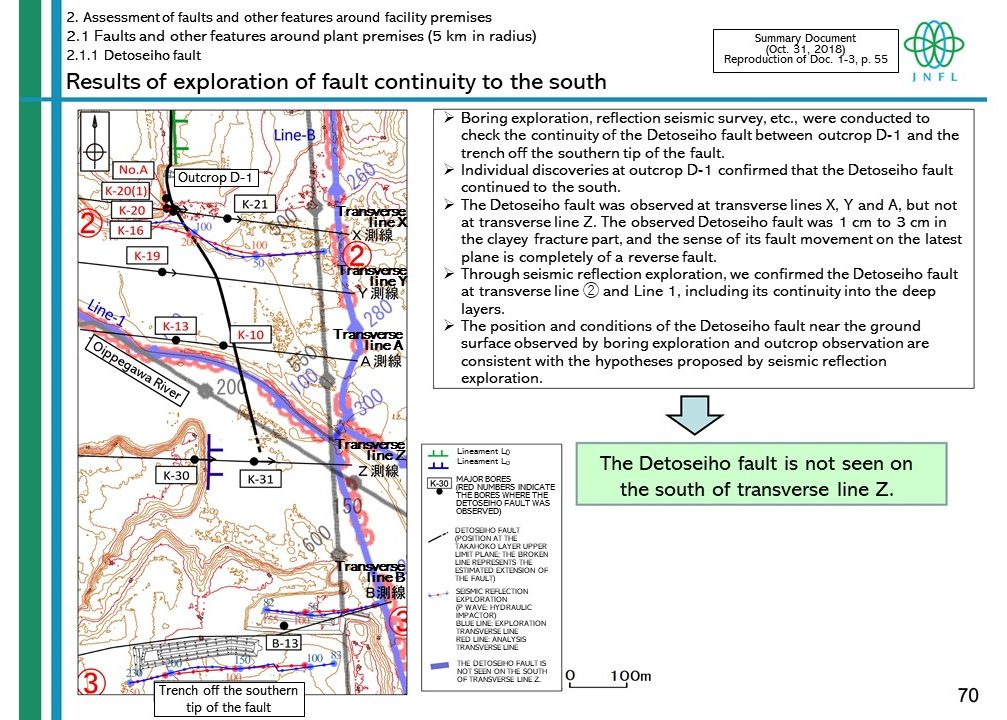
Fig. 3 Exploration of the Detoseiho Fault Southern Tip (from JNFL 2020)
Geological layer deformation and minor faults visible at outcrop 4
JNFL’s illustration of outcrop 4 shows the same layer structures as the landform and geological cross-section Prof. Watanabe pointed out, as introduced in Tsushin Nos. 545 and 592; however, this problem has not been properly discussed at NRA assessment meetings (Fig. 4).
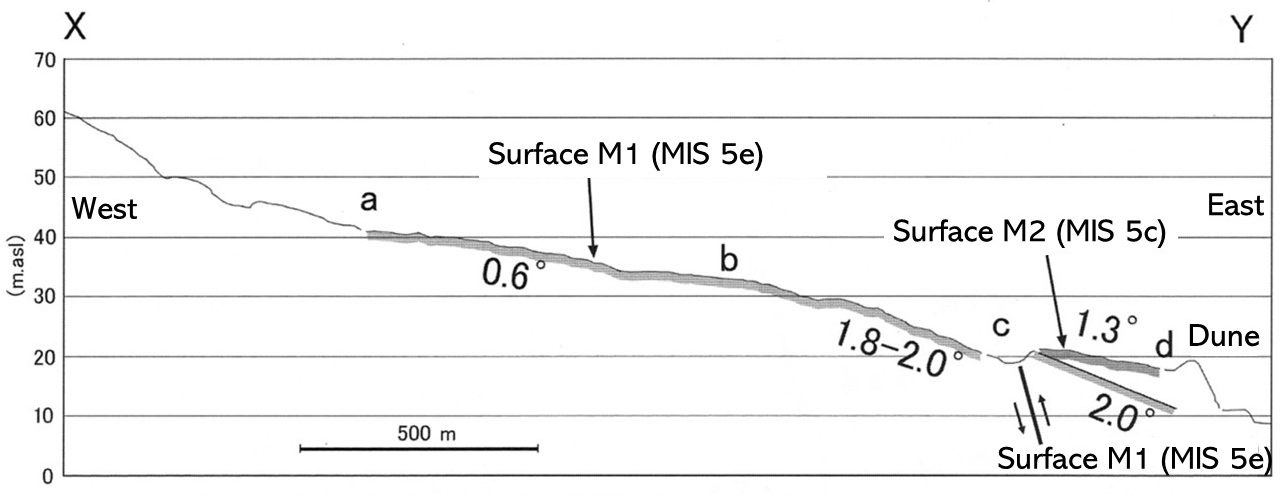
Fig. 4 Geomorphological and Geological Cross Section Showing the Deformation of Surfaces M1 and M2 (Line X–Y in Fig. 2) (Watanabe 2018)
The observation of layers at outcrop 4 shows that surface M1 tilting at 2.0 degrees to the east exists invisibly below surface M2 (marine terrace surface formed 100,000 years ago), which tilts at 1.3 degrees to the east. Surface M1 is abnormally inclined at 2.0 degrees to the east over the area of about 1 km in width east to west. These structures indicate that the sand layer that formed surface M2 deposited so as to abut against surface M1 horizontally, and then surface M2 was deformed by the flexure. This means that an active fault (Rokkasho fault) that deformed both surfaces M1 and M2 exists underground.
Active faults seen in the trench off the southern tip of the fault
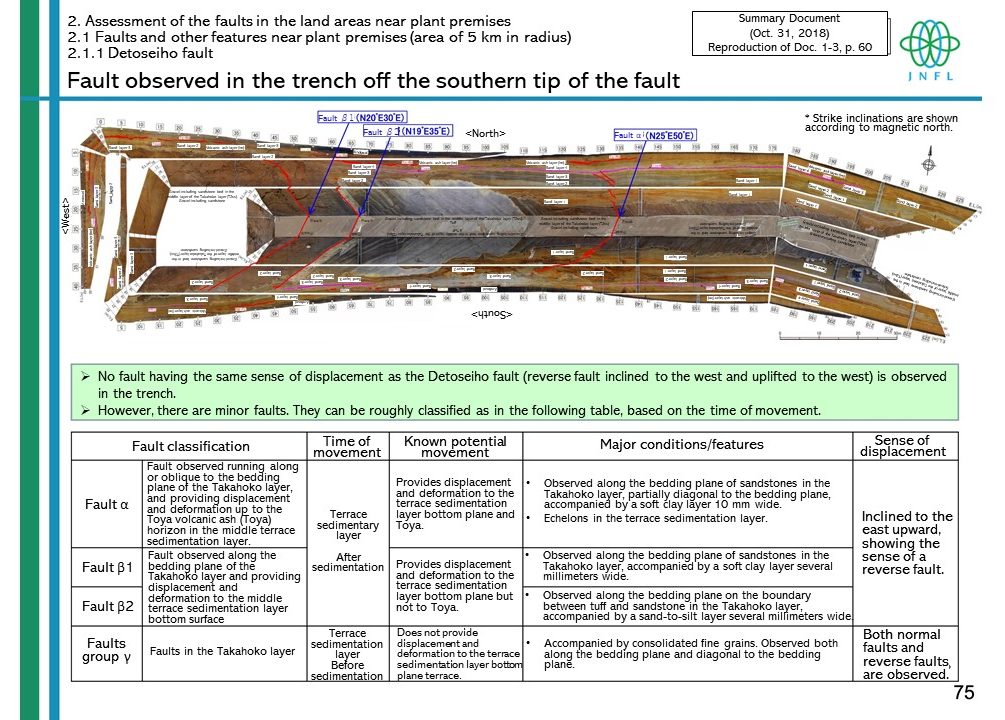
Fig. 5 Active Faults Observed in the Trench off the Southern Tip of the Fault (JNFL 2020)
Fig. 5 is an expanded photograph of the trench off the southern tip of the fault, taken from above. In the trench, there are three small faults (fault α, fault β1, and fault β2). At a level near the trench bottom, an old geological layer (Neogene Takahoko layer formed more than 10 million years ago) is significantly slanted toward the east. All the three small faults exist along the old bedding plane of the geological layer (boundary between two geological layers). This structure is called a flexural-slip fault. In addition, while the Detoseiho fault is a reverse fault inclined upward to the west, all the three small faults are reverse faults that are inclined upward to the east.
As JNFL’s summary indicates, faults β1 and β2 provide displacement and deformation to the bottom surface of the middle-level terrace deposits, but they do not displace or deform the geological layers of the middle-level terrace deposits. However, fault α not only echelons the bottom surface of the middle-level terrace deposits but also the terrace deposits (formed 100,000 years ago) including the Toya ash (ash of the Toya volcano that erupted 112,000 to 115,000 years ago), displacing and deforming the geological layers. Therefore, fault α is an active fault that has moved in the recent 100,000 years.
Flexural-slip fault that provides reasoning for the potential activity of the Rokkasho fault
A flexural-slip fault is subsidiary and does not move independently, which means that it is accompanied by a primary fault. When the primary fault moves, weak parts between geological layers slip and may develop flexural-slip faults. In the case of fault α, the Detoseiho fault or Rokkasho fault nearby is its primary fault. The location where fault α was dug out is on the south of the southern tip of the Detoseiho fault; namely, the Detoseiho fault does not exist there. Therefore, the primary fault that moved fault α is the Rokkasho fault.
Because the Rokkasho fault is active, the Neogene layer is inclined, so that fault α, a flexural-slip fault, slips and moves. The in-depth boring exploration conducted by JNFL on the north of the Obuchinuma Lake indicated that the underground geological layers are significantly curved. The deformation locations of the ground surfaces (marine terrace surfaces) and those of the underground layers are completely in agreement. Prof. Watanabe calls the area where the ground surface is deformed Rokkasho flexure. As the Rokkasho fault moved, the old geological layers (Neogene layers) were pressed and curved, developing the Rokkasho flexure. As the Neogene layers were pressed and curved, the boundaries of the geological layers slipped, producing flexural-slip faults such as fault α.
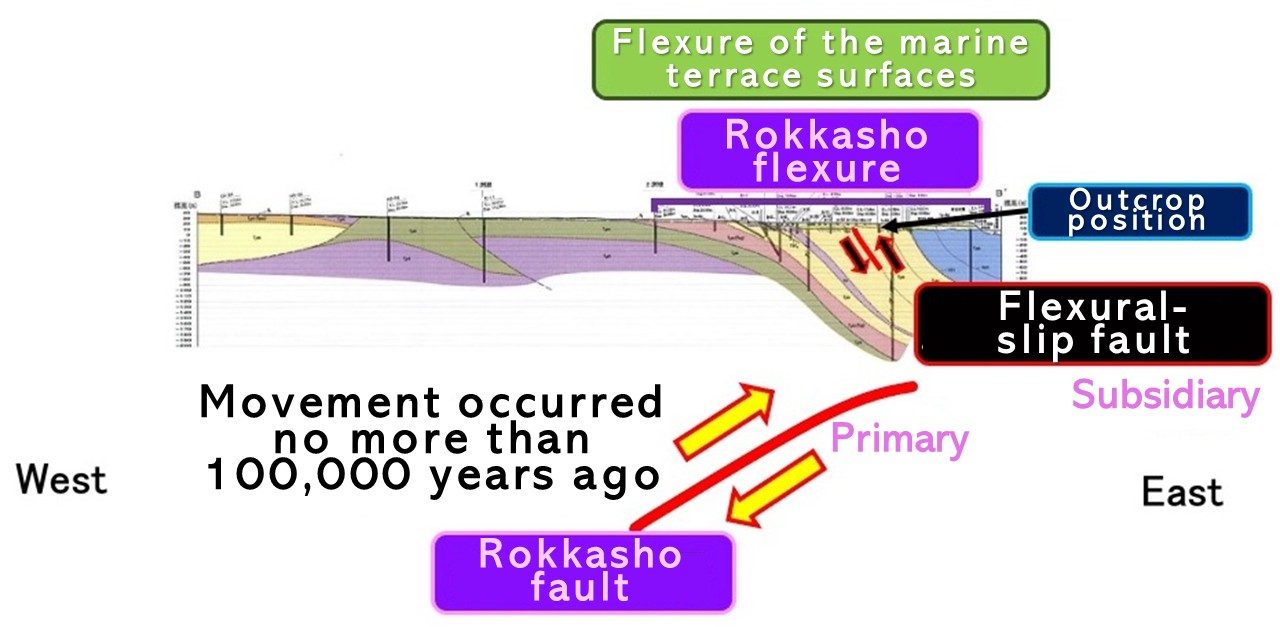
Fig. 6 Flexural-slip Fault (Fault α) is Basis of the Existence of the Rokkasho Fault (Watanabe Mitsuhisa 2019a with author’s modification)
Fault α deformed the 100,000-year-old geological layers, so that the Neogene layers have been pressed and curved to date in the recent 100,000 years. As discussed here, fault α is proof that the Rokkasho fault has been active in the recent 100,000 years and developed the Rokkasho flexure. Fig. 6 drawn by Prof. Watanabe clearly shows this mechanism.
Fundamental underestimation for earthquake resistance
JNFL says that, to determine standard seismic motion Ss, the company considered the Detoseiho fault to be longer than its actual length to count in such faults as fault α as subsidiary faults. However, because the company fails to prove that fault α was moved only by the Detoseiho fault and not by the Rokkasho fault, JNFL does not prove that the Rokkasho fault has no possibility of moving in the future. This is because the Detoseiho fault is presumably a subsidiary fault of the Rokkasho fault.
JNFL slightly extended the length of the Detoseiho fault to determine standard seismic motion Ss, excluding the Rokkasho fault and continental shelf fringe fault, both of which should have been included in the scope of the assessment.
▪ References
Watanabe Mitsuhisa, 2016. “Marine Terrace Surface Deformation and Geomorphological Development in the Vicinity of the Rokkasho Fault,” Active Fault Research, No. 44, 2016 (in Japanese).
www.jstage.jst.go.jp/article/afr/2016/44/2016_1/_article/-char/ja/
Watanabe Mitsuhisa, 2018. “Rokkasho Flexure Forming an Extensive Flexural Scarp — For Proper Assessment by the Nuclear Regulation Authority,” Science Journal Kagaku, Iwanami Shoten, Publishers, Vol. 88, No. 1, January 2018 (in Japanese).
Watanabe Mitsuhisa, 2019a. “Questions about the Assessment of Active Faults in the Vicinity of Rokkasho Reprocessing Plant,” Third Session of the Serial Learning Program “Questioning the Safety of Rokkasho Reprocessing Plant” organized by Stop Reprocessing! Group of Citizens in the Metropolitan Tokyo Area, June 28, 2019 (www.youtube.com/watch?v=4EuD6qPvhE8&t=27s).
Watanabe Mitsuhisa, 2019b. “Problems concerning the Assessment of the Rokkasho Fault— For Proper Assessment by the Nuclear Regulation Authority (3,” Science Journal Kagaku, Iwanami Shoten, Publishers, Vol. 89, No. 12, December 2019 (in Japanese).
Kudo Takashi, Komatsubara Junko, Uchino Takayuki, Kon Yoshiaki, and Miyakawa Ayumu. Geological Map of Japan 1:200,000: Noheji (2nd ed.) (2021). Geological Survey of Japan, National Institute of Advanced Industrial Science and Technology (AIST).
gbank.gsj.jp/geonavi/geonavi.php?lat=40.947676&lon=141.438477&z=11&layers=1356
(GeoMap Navi, gbank.gsj.jp/geonavi/)
Japan Nuclear Fuel Ltd., 2015. “Document 1-1 for the 46th Assessment Meeting for Compliance of Nuclear Fuel Facilities with New Regulatory Standards: Exploration of the Detoseiho Fault among Active Faults in the Vicinity of Reprocessing Plant and MOX-fuel Processing Plant Premises (Responses to Comments),” Feb. 20, 2015
www.da.nra.go.jp/detail/NRA022002509
Japan Nuclear Fuel Ltd., 2020. Electronic Document 1-3 for the Assessment for Compliance with New Regulatory Standards of the Rokkasho Reprocessing Plant and Radioactive Waste Management Facilities: Exploration of Active Faults near the Premises of Reprocessing Plant, Radioactive Waste Management Facilities, and MOX Fuel Processing Facilities, July 13, 2020
warp.ndl.go.jp/web/20250502124906/https://www2.nra.go.jp/data/000318371.pdf