Who’s Who: Chiba Yumi (Director, TEAM Mama-bec Children’s Environmental Protection Corps, NPO Happy Island ☆ Network staffer)
By Ohno Saaya (Playwright and Director, NPO Happy Island ☆ Network staffer,)
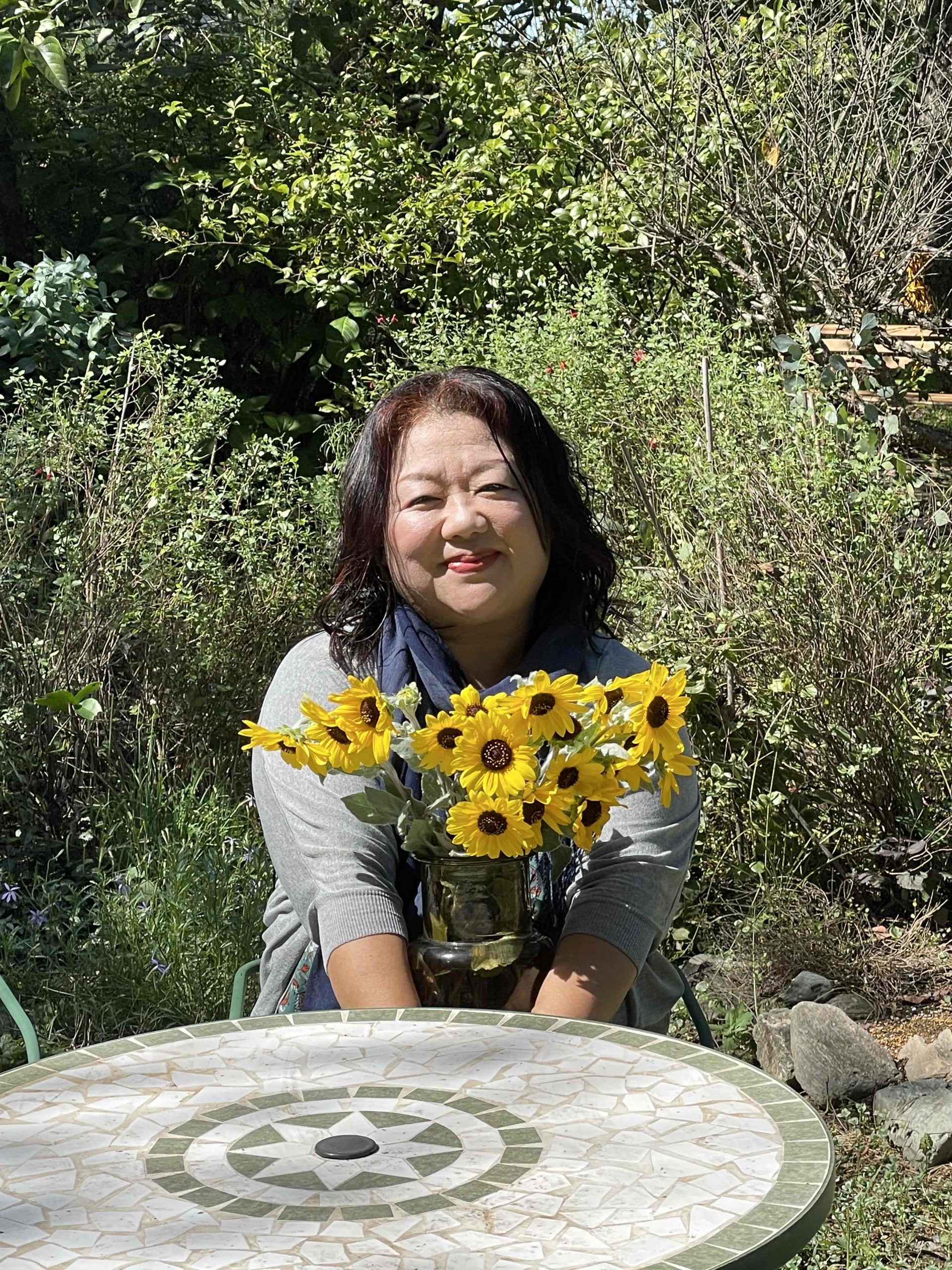 Everyone calls Chiba Yumi-san “Chiba Yumi.” Though I am more than 20 years younger than her, I always call her “Chiba Yumi,” without the “san,” so I will also use that affectionate nickname in this article.
I first came into contact with Chiba Yumi through an interview survey of people who remained in Fukushima after the accident at the Tokyo Electric Power Company Fukushima Daiichi Nuclear Power Station. She was living in Iwaki City (in the southernmost corner of Fukushima Prefecture) as a mother struggling to raise her two children, who were in high school and elementary school, and working with anxious mothers to protect children from radioactive contamination. I was working at the office of the journalist who was conducting the interviews, making appointments by phone and reviewing interview footage and manuscripts. In the Tokyo office, I watched the footage of her in tears as she talked about her emotional turmoil, which also brought me to tears. I first met her in person at the Global Conference for a Nuclear Power Free World held in Yokohama in 2012. “Wow! I didn’t know you were that young!!” She was staring at me in amazement, possibly because I had been quite cheeky to her on the phone. For my part, it turned out to be a first meeting filled with laughter brought on by the incongruity of the gap between the demurely tearful woman in the footage and the woman standing in front of me. In the 15 years since, Chiba Yumi has been one of the women I admire most for continually showing me a way of life that never gives up, as well as being a charming friend with whom I can enjoy uproarious laughter with each other’s jokes.
Even as the myth of the “absolute safety of nuclear power plants” has collapsed and the momentum toward the new safety myth of “it’s OK even if an accident occurs” is being established, Chiba Yumi has resisted nuclear power with all her might. The pillar of these activities is the Team Mama-bec Children’s Environmental Protection Corps, which has been working with mothers in Iwaki City since 2013 to measure radiation levels and soil contamination levels in children’s environments. The team continues to measure and demonstrate through data that the contamination is actually harmful, not simply “unfounded rumors.” While 15 years has now passed since the nuclear accident, high-level contamination hotspots still exist in parks where children play. Based on the results of these measurements, the team negotiates with the related city departments, persistently demanding that they decontaminate the area and ensure that citizens are fully aware of the contamination. These efforts are certainly bearing fruit and making progress, and though the city’s website now includes a link to Mama-bec’s measurement data, the local government’s response to actually detected contamination has become increasingly sluggish. The city’s disregard for safety measures on the grounds that they are not in line with national policy or that there is no budget is deeply wearying. But Chiba Yumi cannot simply say that it cannot be helped. How can we turn a blind eye to a toddler playing in a place we know to be highly contaminated? Making invisible harm visible highlights invisible human rights violations. Further, resisting human rights violations signifies a desire to protect not only the children who are here right now, but also children who are far away or still to come in the future.
When Chiba Yumi was a child, her new father, her stepfather after her mother remarried, would at times show his family a violent side because of his youth and alcohol. As she grew up, she found it difficult to accept the contradiction that her stepfather, who had a high social status, helped the disadvantaged but abused his wife and children at home. She grew frustrated with her mother’s inability to resist, and her rebellious spirit of not wanting to give in to powerful forces became the core of Chiba Yumi’s life. Women who were unable to raise their voices under the control of men, the state of poor local governments that were beaten with wads of cash and bowed to their interests, especially in the Tohoku region, which has been continually trampled on by the central government. She saw firsthand the structure of a society in which the weak were always placed at a disadvantage. After her own child was born with atopy, she began to confront environmental problems. She could no longer ignore the serious environmental problems that were casting a shadow over our lives as a result of our willingness to destroy nature and prioritize the economy.
When the nuclear accident occurred, she felt that she had finally been personally caught up in a disaster. This was the moment when she suddenly and undoubtedly became an “affected person.” She became fully aware of how much suffering people who had been involved in disasters, pollution, and persecution went through. She also realized that not only was she a victim of the nuclear accident but at the same time was responsible for serious pollution of the land, sea, plants, and animals. That’s why Chiba Yumi never stops working, because she not only seeks redress as a victim but also shoulders responsibility as a perpetrator.
Reading this you might get the impression that she is a very serious person with a furrowed brow, but as I wrote at the beginning, Chiba Yumi is a very funny and charming person. She is also brilliant at making sexy jokes. When she jokes around, she puts more energy into it than anyone else I know. I can’t tell you how many times we’ve doubled up in laughter together. She loves growing plants and cooking; she serves huge amounts of fabulously delicious homemade food whenever I visit her home. Together with her husband, Chiba Yumi has renovated every nook and cranny of her home, which is a very comfortable place where old tools and furniture are taken good care of, and handmade and treasured items are tastefully arranged.
When outside of her home, Chiba Yumi has cherished connecting with people in comfortable surroundings. She talks with people while cooking, doing things by hand, and drinking tea. Delicious food, fun, and a healing atmosphere loosen people’s hearts. With a more open heart, little by little, she weaves together moments where people can express their true feelings.
Many things hurt, frustrations are as countless as the stars, and there are times when she is so sick of it all that she just wants to give up. She said, “I’m trying not to push myself too hard these days,” but from my point of view, Chiba Yumi is always overexerting herself, so I want her to look after herself better. But I also know that for Chiba Yumi, who doesn’t want to give in to powerful forces, not giving up is the way she takes care of herself. So, instead of saying “don’t push yourself too hard,” I think saying, “I won’t give up, either” will give her more energy. I will do what I can to be proud to say, “I won’t give up, either,” and continue to roll about laughing with Chiba Yumi as much as possible.
