Underestimating Neutron Irradiation Embrittlement: NRA’s Sloppy Counterargument
By Aono Yuuta, National Institute of Technology Kurume College, Nuclear Power Plant Aging Problem Research Group
Introduction
Issues #617-#620 of the CNIC Tsushin (NIT issues #229, #230, #231, #232) reported on the Nagoya District Court’s verdict and the ensuing appeal by the Group of Citizens Seeking a Court Decision Ordering the Decommissioning of Nuclear Plants Over 40 Years Old.1 One of the reasons for the appeal is that this is an “assessment that can perform a conservative future prediction about the reactor pressure vessel (RPV)” is not true. The future prediction of RPV neutron irradiation embrittlement is performed in accordance with JEAC4206-2007. As commented on by Prof. Ino Hiromitsu in Tsushin #620 (NIT #232), calculating according to the “equivalence assumption” in JEAC4206-2007 leads to an underestimation of the temperature transition, resulting in an assessment on the unsafe side. This is also explained in the reason for the appeal, but the Nuclear Regulation Authority’s (NRA’s) counterargument2 submitted to the Nagoya District Court was an extremely sloppy document. This is what I would like to report on in this article.
Prediction of nuclear irradiation embrittlement by temperature shift
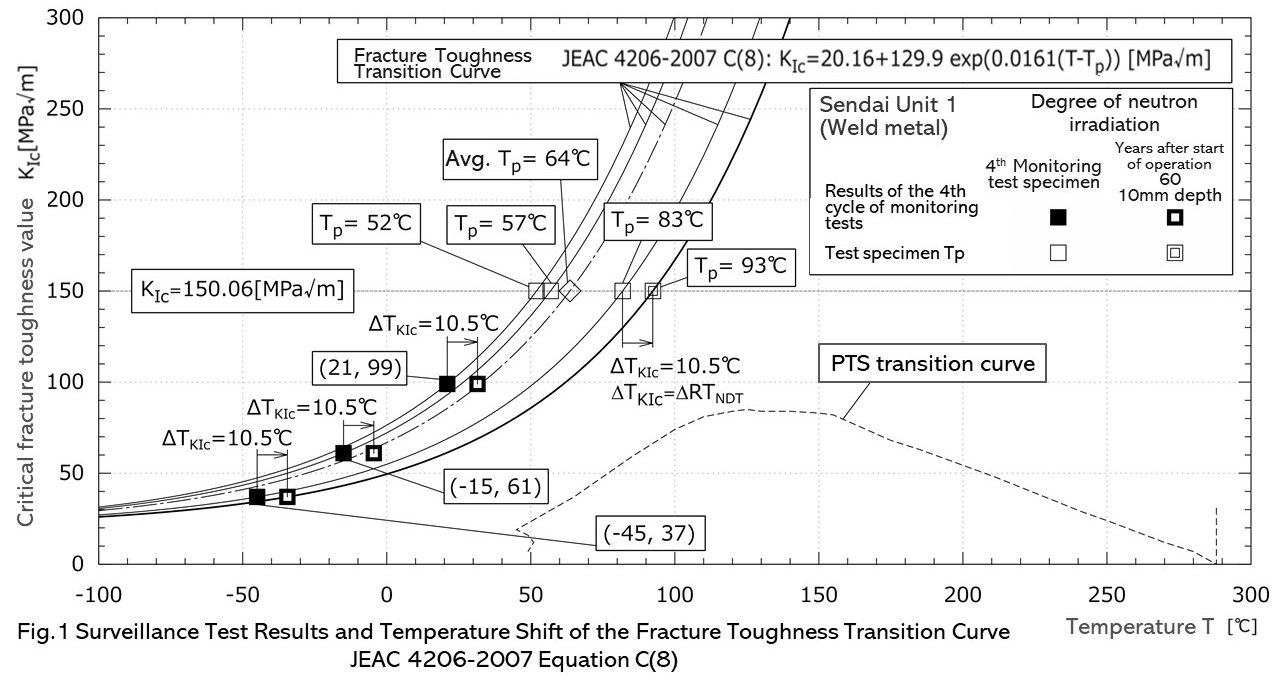
I will refer to Fig. 1 in the explanation of the prediction of nuclear irradiation embrittlement in RVPs. As Sendai Nuclear Power Plant’s (NPP’s) Units 1 and 2 are invoked in the counterargument to the appeal trial, I have used monitoring test data from Sendai Unit 1. Fracture toughness values are used to express the strength of the RPV against faults (cracks) and in Fig. 1 the fourth surveillance data (fracture toughness values at the test temperature) are indicated by the ■ mark. In JEAC4206-2007, the temperature distribution of the fracture toughness values is shown using the equation C(8) fracture toughness transition curve, as in Fig. 1. If the three temperatures Tp for the three surveillance test results (T,Klc )=(-45,37),(-15,61),(21,99)[℃,MPa√m] are 83◦C, 57◦C, and 52◦C, respectively, it is possible to draw the equation C(8) fracture toughness transition curves that pass through the each of the surveillance test results. Of these, whether or not the lower bound curve for the highest Tp, which is Tp=83◦C in this test, intersects with the pressurized thermal shock (PTS) transition curve is used to confirm safety. As the neutron fluence received by the test specimens differs from that at a depth of 10mm from the inner surface of the RPV at the time of 60 years since the beginning of operation of the NPP, it is not possible to measure the fracture toughness value required for the assessment directly. Thus, all the surveillance test results and the fracture toughness transition curve are shifted in the direction of temperature in accordance with the neutron fluence. This is called temperature shift. The Tp in equation C(8) is that parameter of the fracture toughness transition curve, Tp being increased along with the increase in the neutron fluence, thus shifting the fracture toughness transition curve toward the high-temperature side.
New findings regarding the “equivalence assumption”
Fig. 1 was calculated in accordance with JEAC4206-2007 and the temperature shift of fracture toughness, ΔTKIC, was calculated at 10.5◦C from the difference between the neutron fluence of the fourth surveillance test specimens and that at a depth of 10mm from the inner surface of the RPV at 60 years after the beginning of operation of the NPP. In Fig. 1, the shifted fracture toughness values of the fourth surveillance are plotted using the ■ marks with white centers to show the fracture toughness for the neutron fluence at a depth of 10mm at 60 years after the beginning of operation. The temperature shift of fracture toughness ΔTKlc is calculated from the following equation (1) using the temperature shift of the reference temperature (equal to the toughness transition temperature calculated from the Charpy test), ΔRTNDT. Equation (1) is based on the “equivalence assumption” that ΔTKlc and ΔRTNDT are equivalent.
ΔTKlc=ΔRTNDT (1)
When the future prediction is performed, ΔRTNDT is estimated as the sum of the value calculated using the formula in JEAC 4201, with neutron fluence, neutron flux, and material compositions as variables, and a margin to include the measured values. (Expressions used differ from JAEC4206-2007.) Prof, Koiwa Masahiro has pointed out3 that there is a dimensional inconsistency in the reaction rate equation used to derive the formula for calculating ΔRTNDT that has not been rectified for more than 10 years. Further, a recent analysis that has calculated ΔTKlc and ΔRTNDT from all surveillance test data from Japan’s pressurized water reactors (PWRs) without using this formula, has clarified the relationship with the highly linear equation (2).4
ΔTKlc=aΔRTNDT (2) (Base metal: a = 1.32, Weld metal: a = 1.44)
Underestimation of the temperature shift
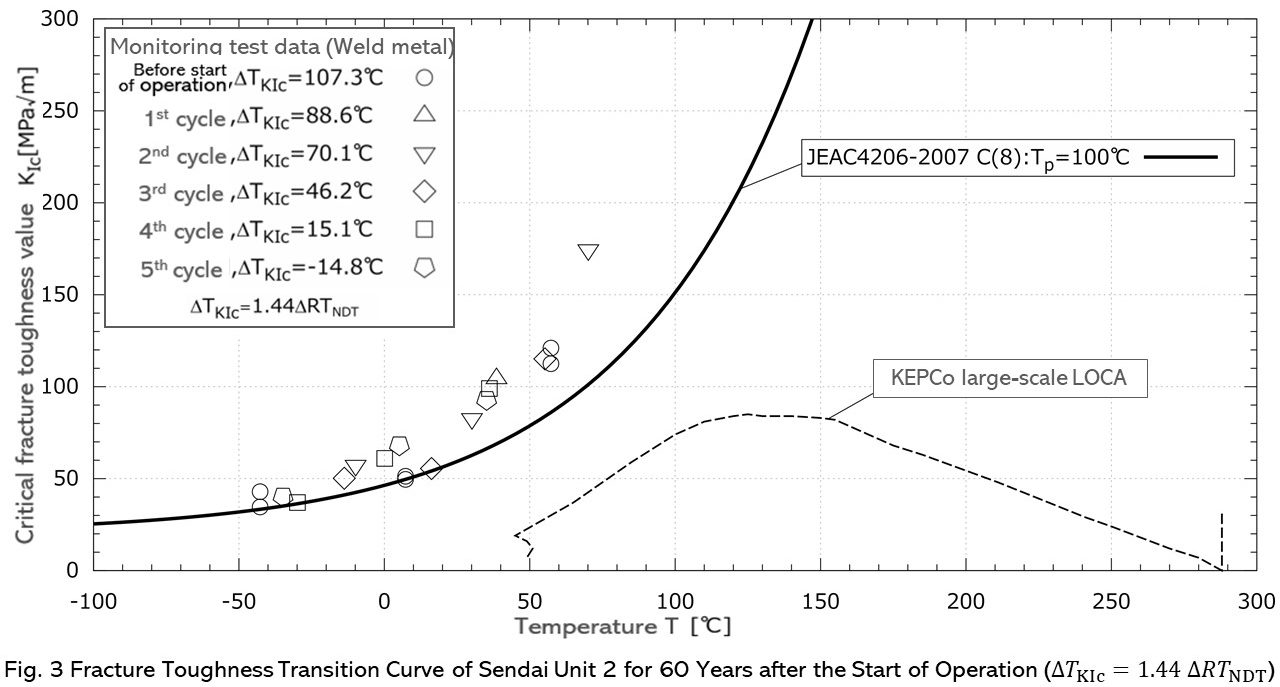
The “equivalence assumption” leads to an underestimation of the temperature shift. Each surveillance test results and the fracture toughness transition curve on the weld metal in Sendai Unit 1 for 60 years after the beginning of operation of the NPP are shown in Figs 2 and 3. Fig. 2 is the assessment when a=1, the assessment according to the “equivalence assumption”, and Fig. 3 is the assessment when a=1.44. For the temperature shift when a=1.44, all the surveillance test data approach the single curve and data scatter is reduced. Under the “equivalence assumption,” the temperature shift is insufficient and clearly unreasonable. The fracture toughness transition curve for Tp=93◦C in the case of the “equivalence assumption” represents an unsafe assessment compared to that for Tp=100◦C when a=1.44. Since equation (2) is a relationship resulting from all surveillance test data from Japan’s PWRs, the temperature shift for all Japan’s PWRs under the “equivalence assumption” are underestimates.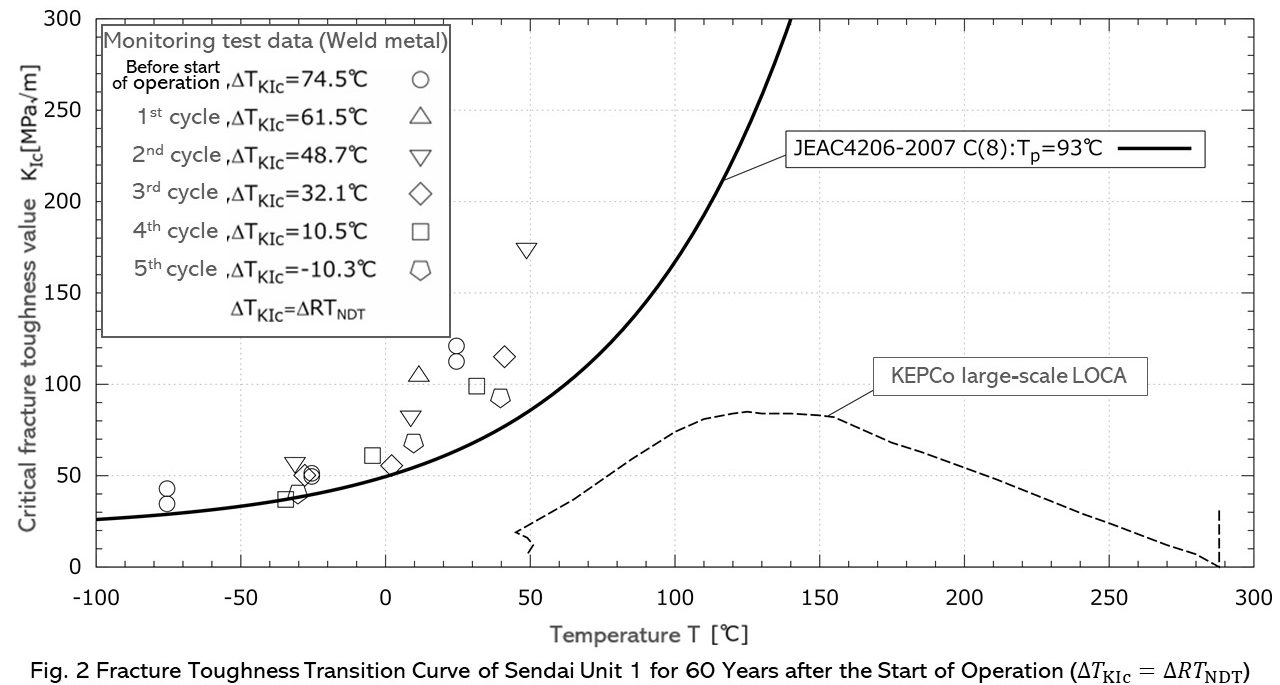
NRA’s sloppy counterargument
The NRA appeal trial counterargument states that there is no basis for the claim that the “equivalence assumption” is unreasonable, that it cannot be said that equation (2) is knowledge at a level that can be justified as a legitimate opinion, and that the plaintiffs’ argument is not one that immediately overturns the widely and internationally recognized “equivalence assumption.” It is this counterargument itself that is unreasonable. Equation (2) is the result of calculations in accordance with JEAC4206-2007 using all the results of surveillance tests in actual NPPs and is therefore objective and scientific fact. Consideration of the technical aspects of how this should be reflected in JEAC4206 is necessary. However, the “equivalence assumption” itself does not fit the surveillance test results. In other words, the “equivalence assumption” is unreasonable.
Errors and verification lapses in the Sendai Units 1 and 2 report
That the temperature shift under the “equivalence assumption” is insufficient can be explained using the PTS assessment (figures equivalent to Figs. 2 and 3 for Takahama Unit 1). Each time the latest surveillance test results are added, the fracture toughness transition curve is updated by shifting to the right. This is because the temperature shift under the “equivalence assumption” is underestimated even though the neutron embrittlement increased more than predicted.
To this, the defendant, NRA, claims that the maximum values of Tp at Sendai Unit 15 were determined by the result of the third surveillance test not by the result of the fifth surveillance test, and at Sendai Unit 26 were determined by the result of the third surveillance test not by the result of the fourth surveillance test. NRA insisted that therefore the “equivalence assumption” is not erroneous. However, since fracture toughness is known to have significant scatter, the number of monitoring test specimens few, and the period between surveillance tests is irregular, there are probably nuclear reactors that show a different trend from that of Takahama Unit 1. I tried checking the “equivalence assumption” for Sendai Units 1 and 2. The result for Sendai Unit 1 is as shown in Figs. 1 and 2, and naturally the “equivalence assumption” for Unit 2 was also unreasonable.
During the calculations I noticed that there were two errors in the Kyushu Electric Power Company (Kyuden) report. The first of these was that the PTS assessment was not performed at the depth of 10mm as stipulated by JEAC4206-2007, but was conducted at the inner surface of the RPV. The second was that some results achieved at low-temperature are excluded from the calculation of the Tp values. This means that the maximum of the Tp may be underestimated.
Regarding the first error, I calculated the neutron fluence and ΔRTNDT at the inner surface, a depth of 10mm, and 1/4 of the RPV thickness in accordance with the report. The values ΔRTNDT in the report matched with those at the inner surface and 1/4 of the specimen thickness. The fracture toughness transition curve shown in the report predicted the fracture toughness at the inner surface. However, the fracture toughness at a depth of 10 mm should be calculated because JEAC 4206-2007 requires an “assessment using an assumed semi-elliptical crack with a width of 60 mm and a depth of 10mm”.
Regarding Tp in the second error, in the table of all surveillance test results in the report, some cells for Tp values that were calculated from data tested at low-temperature contain no value, only “-”. For example, of the three Tp values shown in Fig. 1, the Tp data from the lowest temperature test, -45◦C, would be the maximum value, but Kyuden has excluded this data from the assessment. I checked the Sendai Unit 2 report, and it contains exactly the same errors. When assessing all surveillance test results from Sendai Unit 1 correctly, the Tp value in the fourth surveillance test results, shown in Fig. 1 (or in Figs. 2 and 3), is the maximum value. In contrast, in the appeal trial NRA counterargument, similar to the Kyuden report, the maximum value of Tp is shown as in the third surveillance test results. In other words, NRA has probably not verified the Kyuden report.
The RPVs in Sendai Units 1 and 2 contain relatively small concentrations of copper, which has an adverse effect on irradiation embrittlement and, as shown in Fig. 3, these are not reactors that can be recognized as having an immediate irradiation embrittlement issue. However, that is something that should be said after having performed assessments correctly in accordance with the regulations. In fact, the first error errs on the conservative side, but the second, with regard to Sendai Unit 1, errs on the unsafe side. Even a comparison with Fig. 2, which uses the “equivalence assessment,” the final Kyuden assessment of Tp=88◦C is an assessment that errs on the unsafe side. I fervently hope that NRA will fulfill its role as regulator, including the awareness of the “equivalence assumption.”
Acknowledgements
I would like to express my deep gratitude to Prof. Ino Hiromitsu, Takashima Takeo, Goto Masashi, Shibayama Yasuko, Yamaguchi Yukio and Kamisawa Chihiro of the Nuclear Power Plant Aging Problem Research Group
References and materials
(1) CNIC Tsushin #617-#620, cnic.jp/80548 cnic.jp/80557 cnic.jp/81734 cnic.jp/81739 and NIT issues #229-#232 cnic.jp/english/?p=8803 cnic.jp/english/?p=8914 cnic.jp/english/?p=9053 cnic.jp/english/?p=9207
(2) toold-40-takahama.com/resources/kososin_takahama2/
(3) Koiwa Masahiro, Kinzoku, vol. 85. no.2. pp. 87-100. 2015.
(4) Aono, Ino, Kinzoku, vol. 94. no.9. pp. 807-815, 2024.
(5) www.da.nra.go.jp/view/NRA022011183?contents=NRA022011183-002-008#pdf=NRA022011183-002-008
(6) www.da.nra.go.jp/view/NRA022011183?contents=NRA022011183-002-021#pdf=NRA022011183-002-021