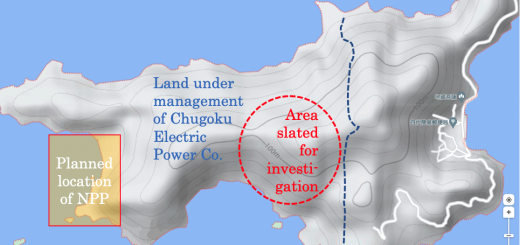
Study on Implementing Geological Disposal in Minamitorishima – Considering the Volumes of Materials Involved
By Matsukubo Hajime
A literature survey on the final disposal of radioactive waste in Minamitorishima Island has been initiated. I thus decided to examine some of the hurdles toward carrying out geological disposal in Minamitorishima.
Possibilities for Deep Boreholes
The underground geological structure of Minamitorishima is not yet fully understood, but there is said to be up to 1,000 m of coral reef limestone and a layer of basalt created from lava beneath that. Due to high water permeability, limestone is unsuitable for construction of underground facilities. The key to long-term safety of disposed vitrified materials is preventing any movement that could result from groundwater influx. For this reason, some experts have indicated the possibility of disposal in ultra-deep holes (deep borehole disposal).
Deep borehole disposal is a method involving drilling boreholes several kilometers deep and lowering the objects to be disposed of therein, but it is still in the research stage. In this case, holes with a depth of 3 km and a final diameter of 76 cm are to be dug, with the disposal zone assumed to be 2.5 to 3 km down. If the vitrified objects to be disposed of have a height of 1.3 m, and with cushioning and other materials bringing the total height to 2 m, it was calculated that it will be possible to dispose of 250 vitrified objects per borehole.
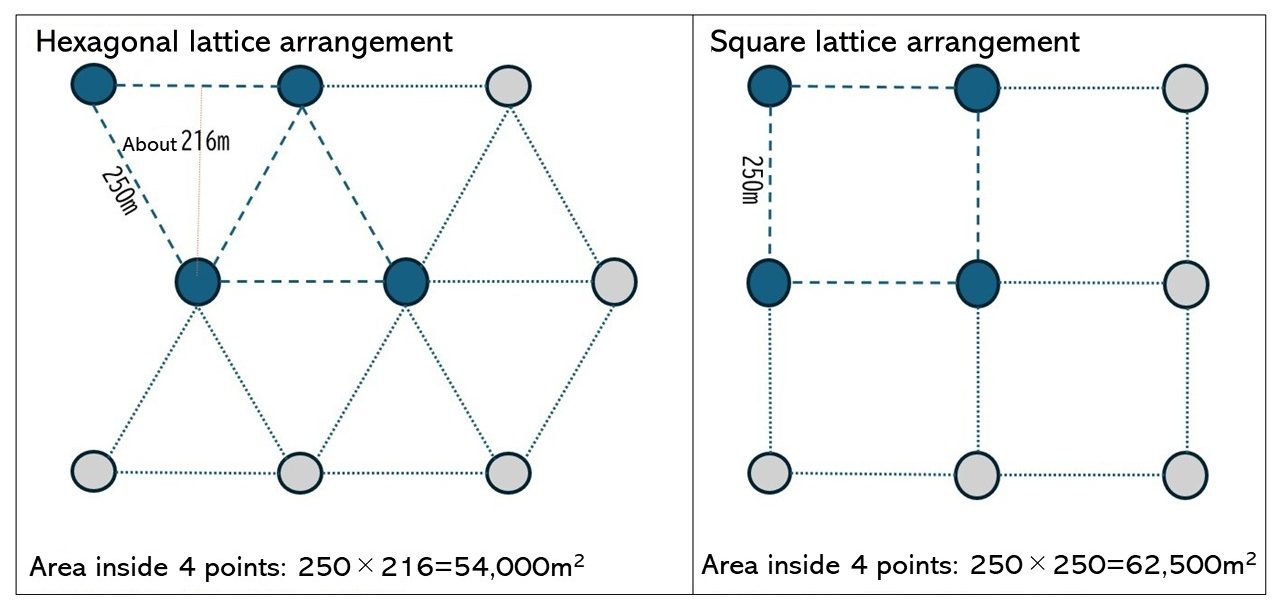
Fig. 1 Borehole arrangement.
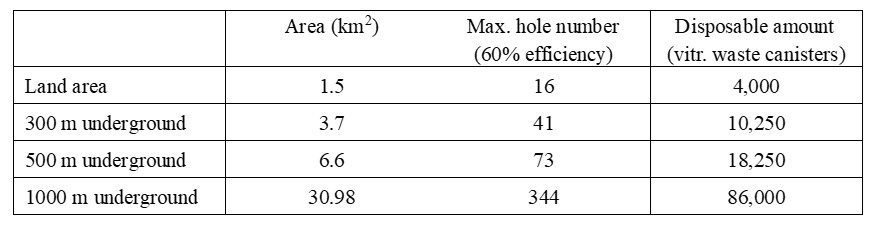
Table 1 Estimation of numbers of deep boreholes in Minamitorishima.
Considering decay heat, there will need to be a certain interval between these deep boreholes. This spacing may be from 150 to 360 m according to the literature on the subject, depending, apparently, on assumed calorific value and thermal conductivity. Say the interval is 250 m; the unit cell will be a rhombus of 54,000 m2 in a hexagonal lattice or a square of 62,500 m2 within a square lattice. The hexagonal lattice occupies less space, so it tends to be favored in conceptual designs.
The author examined deep borehole disposal from the perspective of the area of Minamitorishima. Even if the island has a certain area, it would not be possible to use it all for disposal, so the usable area was calculated at 60 percent. The results are summarized in Table 1. Each disposal facility is to hold 40 thousand vitrified objects. The upshot is that for disposal at Minamitorishima, it would be necessary to dig a vertical shaft to about 1,000 meters depth to secure a sufficient area, and create a large enough underground space there for boring.
For boring, a tower would need to be erected, but because an onshore drilling rig used for oil extraction with a drilling depth of 3.5 km, for example, has a total height of about 40 m, the underground space would have to have a height of at least 40 m. Excavating such a large space 1,000 m underground would present technical difficulties.
Note that boring from above the sea into the ground beneath Minamitorishima was also considered, but it would conflict with the London Convention and Protocol, so it is not an option. The deep borehole proposal can be considered impossible to implement at this time, at least in Minamitorishima.
Amount of Soil Excavated for Geological Disposal and Potentials for Transporting It
According to the Nuclear Waste Management Organization of Japan (NUMO), the amount of soil that would need to be stored temporarily in the case of drilling 1,000 m down through the hard rock along the coast and considering colocation with trans-uranic and other wastes, would come to 10,466,868 m3.
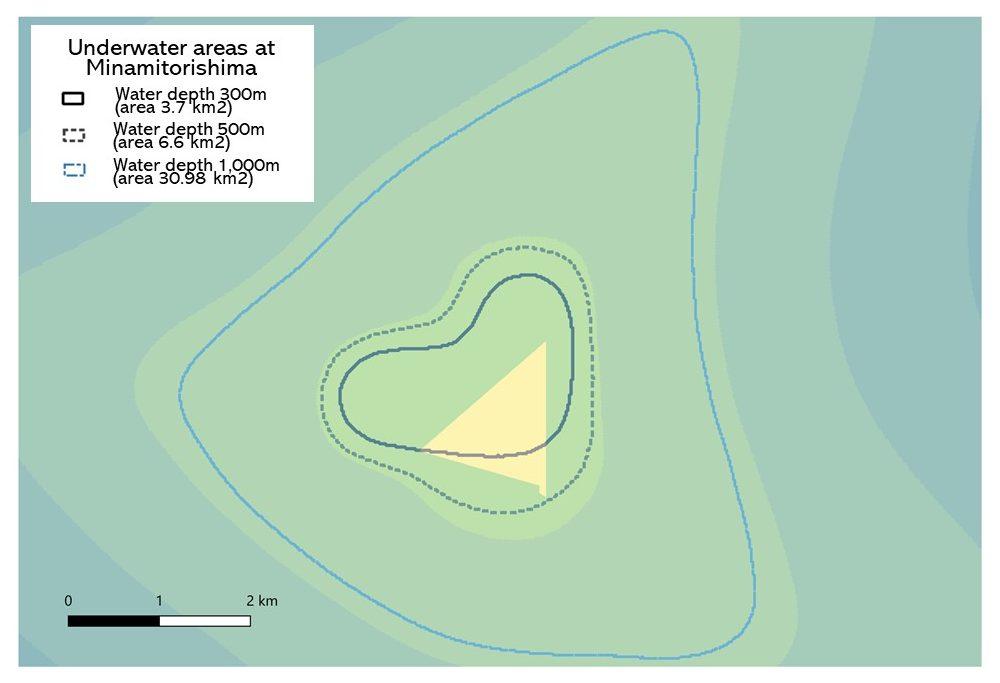
Fig. 2 Underwater areas around Minamitorishima. (Data source: Global Multi-Resolution Topography synthesis)
Generally speaking, such above-ground facilities occupy about 1 to 2 km2, but Minamitorishima has an area of about 1.5 km2. This would make installation difficult to begin with. Documents presented at a briefing NUMO gave to Ogasawara Village, however, say, “It is possible to reduce the space of the above-ground facility layout by installing facilities that do not necessarily need to be directly above the underground facilities, such as storage sites for excavated soil and facilities for producing clay (buffer material) for covering the outside of metal containers, which can be located in different places.” It may be possible to reduce the size of the layout, but Minamitorishima is a remote island, so it will be necessary to transport everything in and out. What happens if the excavated soil is transported by ship?1)
Firstly, the destination for the excavated soil will be either the Ogasawara islands or somewhere on Japan’s mainland. The Ogasawara islands, however, are registered as a UNESCO World Natural Heritage Site, so dumping it there is not a realistic solution.
Secondly, Minamitorishima is in open ocean, so transportation will be conducted using bulk cargo ships, but it is such a small island and building a port that would enable gigantic cargo ships to dock there is hard to imagine, so the idea is to ship everything using 30,000-ton-capacity cargo ships. The draft of one of these ships is 10 m by 180 m length. The existing port at Minamitorishima has a water depth of 8 meters, necessitating dredging of at least 3 m. Expansion of a port in such a remote place would probably take several years.
And how about the number of shipments needed? The distance from Minamitorishima to Tokyo is about 1,900 km, and from Rokkasho-mura, where the vitrified bodies are produced, is 2,200 km. That is a one-way voyage of about four days. Adding another six days for cargo handling, it would take about 14 days for a round trip. Considering that the port may be rendered unusable during times such as the typhoon season, it could handle about 20 shipments a year. If 10 million m3 of the soil requiring temporary storage consists of basalt rock, it would have a weight of about 30 million tons. If that is being shipped in 30,000-ton-capacity cargo ships, it would require 1,000 trips. If only one such ship were used, that would take 50 years.
Regarding increasing the number of ships used, it is not as simple as that. In particular, since a large port cannot be constructed at Minamitorishima, there is a limit to how much can be handled there. The limit is probably around three ships. Transporting the excavated soil alone would take 17 years. Minamitorishima is an isolated island in the Pacific Ocean, so personnel and access to materials will depend on shipping. If the port is struggling with capacity issues, this reality becomes even more severe.
Note that the transport ship for high-level vitrified waste has a loading weight of 3,500 tons and a draft of about 7 m, so it would be able to use the current port. It would be necessary to install equipment such as cranes, but it would also be possible to use cargo ships of the same size to transport the excavated soil. It would require 8,600 trips, however, to remove it all. Even if there were three ships in use, it would still take 140 years or more. It can clearly be said that construction of a port that large ships could dock at would be essential. Another important point not touched on here is the problem of disposal costs grossly exceeding expectations.
Final disposal at Minamitorishima has been examined here from the viewpoint of the amounts of materials involved, which by themselves confirm the extremely low feasibility of such a project. Was this not discussed prior to the literature survey?
1)In the case of the standard layout, the excavation site occupies an exclusive area of approximately 0.7 km2. In all likelihood, not all of the excavated material would be dealt with off the island, because some would be used for backfilling, but for the sake of simplicity, management of the entire amount off the island is assumed here.
References
・Bates, Ethan (2015) Optimization of deep boreholes for disposal of high-level nuclear waste.
dspace.mit.edu/entities/publication/5384cb09-7d49-46de-ab2f-c9c8b6b7bc0e
・Lee, J., Kim, G., Bae, D.S., Choi, H.J. & Kim, K. (2015) An Analysis on the Borehole Spacing for Deep Borehole Disposal of HLW. rampac.energy.gov/docs/default-source/storage/12684.pdf
・Mallants, Dirk, Sander, R.,Avijegon, Arsham & Engelhardt, Hans-Joachim (2021) Cost Analysis of Deep Large-diameter Drill Holes-21048.
・Japan Coast Guard, Hydrographic Department (2001) 1/50,000 coastal sea basic map in report on seabed topography and geological survey of “Minamitorishima.” (in Japanese)
・Nuclear Waste Management Organization of Japan (NUMO) (2011) Disposal technology and safety regarding geological disposal of low-level radioactive waste—appendix. (in Japanese) www.numo.or.jp/technology/technical_report/tr1101pdf/tr1101b.pdf
・Ministry of Land, Infrastructure, Transport and Tourism (MLIT) (2018) A manual on the development of marine-related technologies in remote islands, in collaboration with industry, academia and government (draft). (in Japanese) www.mlit.go.jp/common/001247601.pdf
・The Japanese Association for Petroleum Technology (JAPT) (2022) (Drilling rig introduction) INPEX and INPEX drilling. (in Japanese) www.japt.org/files/topics/1590_ext_01_0.pdf