News Watch (August 3,2026)
2 to 5 Large Nukes by 2040, 11 to 14 by 2050?
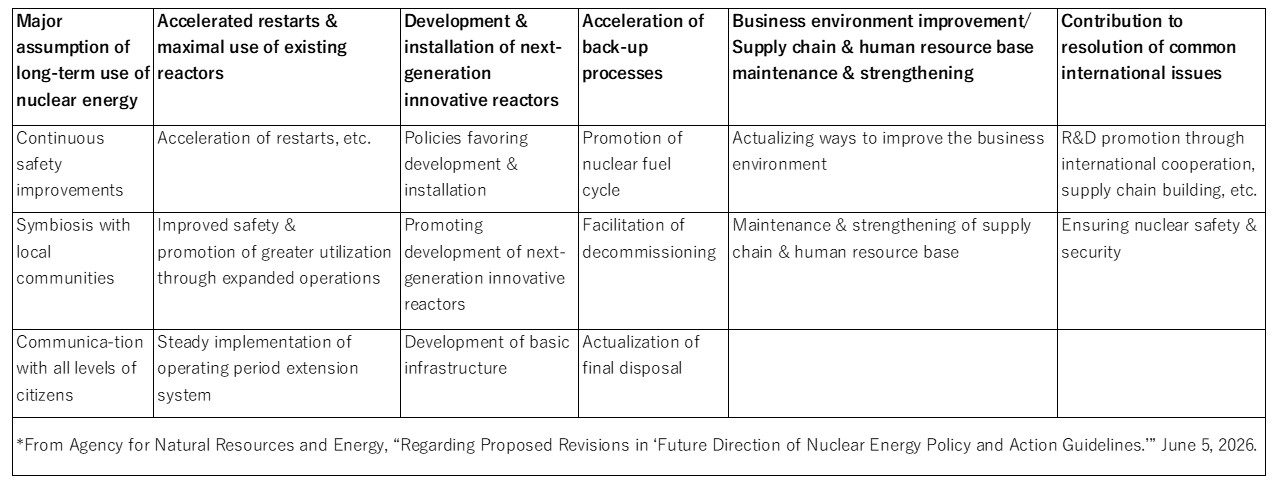
“Future Direction of Nuclear Energy Policy and Action Guidelines,” adopted in April 2024 by the Council of Ministers on Nuclear Energy of Japan’s Cabinet, was revised on July 31, 2026. The table below gives an overview of the content of these revisions. The phrase “long-term utilization of nuclear energy” is used, which was absent from the document two years ago. “Outlook and Future Image of Nuclear Power Generation,” which appears at the beginning of the initial action guidelines, has become “Nuclear power plants need to be rebuilt so that they can produce about 2.2 to 5.5 million kW (about 2 to 5 units) by the 2040s and about 12.7 to 16 million kW (about 11 to 14 units, including those from the 2040s) by the 2050s,” and this is likewise appearing for the first time. Amazingly, what had been simply termed “a necessity” is now being called “the outlook.”
For more on this, see Matsukubo Hajime’s article on his participation in the Nuclear Subcommittee (cnic.jp/english/?p=9321).
Rokkasho Reprocessing Plant Completion to be Postponed for the 28th Time
Japan Nuclear Fuel Limited (JNFL) completed its explanation of its main policies in the examination for approval of its construction plans for installing the Rokkasho Nuclear Fuel Reprocessing Facility (Rokkasho reprocessing plant) on June 8, and reported to Aomori Prefecture and Rokkasho Village on June 12 that it had achieved prospects for completion of its construction. That said, it will still take a lot of time until they can get their application corrected and approved. Moreover, they face an upcoming battle for approval under security regulations.
Whether or not the Rokkasho reprocessing plant can be completed in FY2026 will also be determined by progress in the work schedule for transporting spent fuel across prefectural borders, as Kansai Electric Power Co. (Kanden) is requesting from Fukui Prefecture. Kanden explained to Fukui Prefecture on June 12 that the goal to complete construction of the needed facilities in FY2026 remained unchanged. Steady progress toward completing the Rokkasho reprocessing plant will be key to determining whether Fukui Prefecture will approve dry storage at the nuclear power plant site. Thus the 28th postponement cannot be admitted to until the prefectural government has given its approval.
Whether the construction of the Rokkasho reprocessing plant can be completed in FY2026 will depend on whether or not Governor Miyashita Soichiro of Aomori Prefecture will allow the spent fuel to be delivered to the interim spent fuel storage facility in Mutsu City. Governor Miyashita has stated that he would not accept new deliveries on the grounds that the completion of the facilities could not be expected by the end of FY2026, i.e, March 31, 2027. Kume Takashi, Director-General of the Electricity and Gas Business Dept. at the Agency for Natural Resources and Energy, met with the governor on July 3, saying, “A delay is possible,” to which the governor agreed, “Yes, indeed,” asking that the government provide guidance toward creating a “new work schedule with greater feasibility.” He indicated that he intends to maintain the current suspension of the transfer of spent fuel to the intermediate storage facility for the time being.
With the new work schedule, a 28th postponement of completion of the plant is a certainty.
Data Fabrication Continues at Hamaoka Nuke, Even with Investigation Underway
Chubu Electric Power Co. announced on January 5 this year that selection of representative waves for the seismic motion evaluation at the Hamaoka Nuclear Power Station (Hamaoka NPS) was suspected to have been “carried out in a deliberate manner or differently” from what had been explained at the Nuclear Regulation Authority (NRA) review meeting. What they meant was the standard seismic motion formulation data had been fabricated and falsified (cnic.jp/english/?s=hamaoka). At a meeting of the NRA on July 1, the NRA Secretariat presented its “Report on verification status regarding misconduct by Chubu Electric Power Co.” According to that, even after May 2025, when talks between Chubu Electric and the NRA began as part of an investigation of data provision based on the reporting system, Chubu Electric continued fabricating data for seismic motion evaluation. Worse, they were not simply continuing this practice, but creating a sham in order to cover up their earlier data fabrication.
What newly came to light this time was that there were cases in which nothing but one representative wave set of ground motions existed (where 20 sets were supposed to exist), so they added 19 new wave sets. Chubu Electric explained it off as “a way to facilitate explainability,” but Yamanaka Shinsuke, who chairs the NRA, said, “By inference, this is illegal concealment. It seems like ethics is in short supply among this bunch.”
The NRA’s report describes the main procedures Chubu Electric was using to select fabricated representative wave sets: (1) Ask the contracting business to calculate 1000 wave sets per case. Have calculation results that exceed the selection criteria Chubu Electric presents excluded from selection as representative wave sets. (2) Extract several sets of candidate representative waves from among the calculation results submitted by the contracting business (selection criteria unclear). (3) Request the department in charge of the facility to confirm their impact on the facility. (4) Select one wave set that will ultimately be the representative wave set. (5) Select the remaining 19 wave sets from those with the smallest residuals from the 20-wave-set average value and create one 20-wave set for seismic motion (specific details on the recombination unknown).
“Request the department in charge of the facility” in (3) involved asking for confirmation of the impact of various candidate representative waves given the following three classifications: ○ Okay to select because it will not affect facility design; △ Does not affect facility design, but we still want you not to select this; × Could affect facility design, so selecting it would cause problems.
This went on repeatedly. Appalling doesn’t even begin to describe it. We need a thorough clarification of the truth and a fundamental review of Japan’s nuclear regulatory system.