Lawsuit to Nullify the Rokkasho Reprocessing Plant’s Business License – Updates (1): Potential Activity of Continental Shelf Fringe Fault and Rokkasho Fault
By Kamisawa Chihiro
Recent earthquake off the eastern coast of Aomori Prefecture (December 8, 2025)
An earthquake with a magnitude of 7.5 took place off the eastern coast of Aomori Prefecture (the hypocenter was 54 km deep) at 23:15 on December 8, 2025. Strong quakes were observed over a wide area, especially in the areas along the Pacific coast in Aomori and Iwate Prefectures: In Hachinohe City, a quake intensity of 6 upper was recorded (the maximum acceleration was 517 Gal). A tsunami of 64 cm was observed at the Port of Kuji, Iwate Prefecture, while a 50-cm tsunami reached Urakawa, Hokkaido.
In Rokkasho Village, the seismometer near the village office recorded a quake intensity of 5 lower and a maximum acceleration of 196 Gal as the values near the earth’s surface. In addition, a long-period ground motion of class 3 was observed in the village, indicating that the quakes were so strong as to probably cause construction components such as partition walls to develop cracks or fissures. The size of the quakes measured in the Rokkasho Reprocessing Plant has not been made public. The only one known fact is that the water in the spent-fuel pool sloshed beyond the water stop of a height of 1 meter, such that 650 liters of water overflowed.
At 2:00, December 9, the Cabinet Office and Japan Meteorological Agency released the alert “Off the Coast of Hokkaido and Sanriku Subsequent Earthquake Advisory,” noting that a gigantic earthquake was more possible than usual in the designated seismic source regions along the Japan Trench and Chishima Trench (the advisory was withdrawn on December 16 as the alert period was ended). The designated source regions include the continental shelf fringe fault, which is highly important for assessing the quake resistance of the Rokkasho Reprocessing Plant.
Shimokita Peninsula, continental shelf fringe fault, and Rokkasho fault
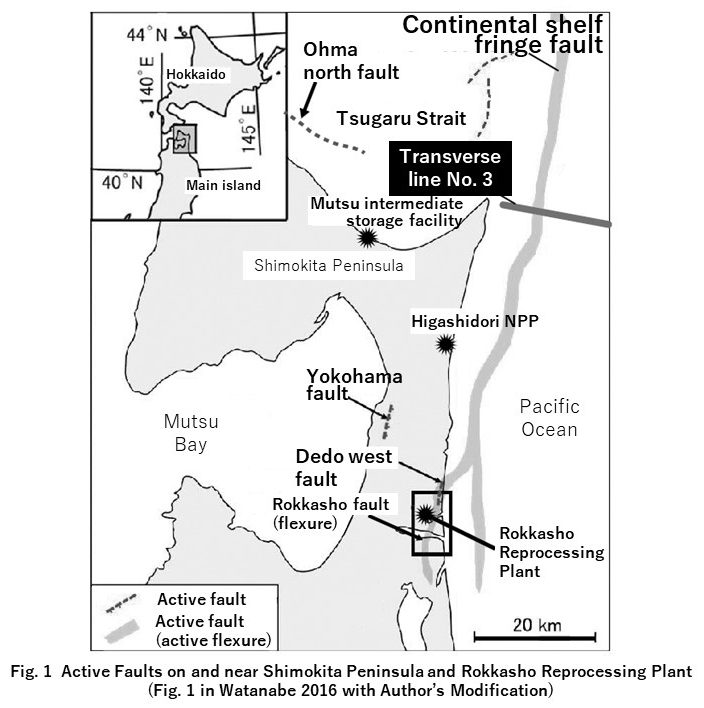 The line running north-south along the eastern coast of the Shimokita Peninsula in Fig. 1 represents the continental shelf fringe fault under the seabed. The fault extends for a total of 150 km. It is forked into two faults near the southern end. One of the southern forked ends runs further to the south under the seabed. The other end is deemed to extend toward the land and run through the premises of Japan Nuclear Fuel Limited (JNFL) nuclear fuel cycle facilities down to the southern shore of Lake Takahokonuma. The terrestrial part of the fault was designated as the “Rokkasho fault” (“Rokkasho flexure”) by Professor Watanabe Mitsuhisa of Toyo University.
I have briefly discussed the potential activity of the continental shelf fringe fault in a number of publications, including the Japanese CNIC newsletter Tsushin No. 545 (November 1, 2019) and No. 592 (October 1, 2023). Our claim that the continental shelf fringe fault is active is based on the facts that the Pacific side of Shimokita Peninsula has marine terraces in series and that, corresponding to the terraces, there are about 200m-high cliffs in series on the seabed.
Offshore acoustic exploration
To deny the activity of the continental shelf fringe fault, the four nuclear operators that run facilities on the Shimokita Peninsula, JNFL, Tohoku Electric Power Co., Tokyo Electric Power Co., and Recyclable-Fuel Storage Co., have conducted various surveys to collect data from which they have fabricated interpretations. One of these fallacies is their interpretation of offshore acoustic exploration data. Offshore acoustic exploration is a survey where acoustic waves are transmitted from a vessel on the ocean surface to learn about the earth layers below the seabed based on the strengths of acoustic wave reflections. Fig. 2 shows the geological interpretation of the records of the acoustic exploration at transverse line No. 3 as in Fig. 1, conducted by Tohoku Electric Power Co. and Tokyo Electric Power Co. (The illustrations show the cross-section obtained by the acoustic reflections.) The upper illustration in Fig. 2 includes the interpretation by Dr. Ikeda Yasutaka, former Nara University Professor (of tectonic geomorphology) and the lower illustration is the interpretation by the operators including JNFL.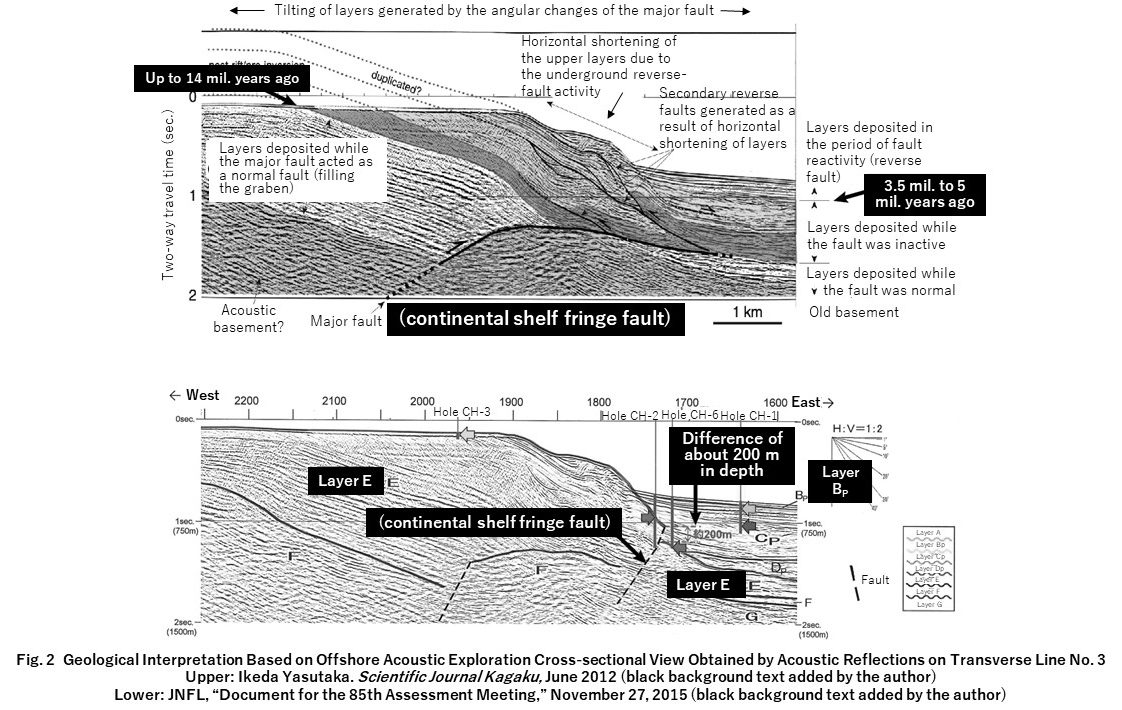 At the oral proceedings of the Lawsuit to Nullify the Rokkasho Reprocessing Plant’s Business License on December 19, 2025, at the Aomori District Court, the author detailed the misinterpretation by JNFL, based on the interpretation by Dr. Ikeda I had previously listened to at an internal learning session (to which Dr. Ikeda had been invited) on April 6, 2016. The misinterpretation by JNFL can be called a fabrication.
Differences in the geological interpretations over transverse line No. 3
I would like to introduce Dr. Ikeda’s interpretation first (the upper illustration in Fig. 2): the continental shelf fringe fault was located in the illustration prepared by the acoustic reflections. When the Japan Sea enlarged and took shape, the continental shelf fringe fault acted as a normal fault under east–west tensile force (up to about 14 million years ago). Then the continental shelf fringe fault was inactive for a period. Thereafter, east–west compressive force started to work on the fault (reversal in the stress field), and the fault started to act as a reverse fault 3.5 million to 5 million years ago, as if to follow the trace of the normal fault. As the fault moved at that time, the sedimentary layers on the continental shelf fringe fault were pressed and deformed, producing continental shelf slopes. The movement of the fault also produced many faults because weak parts between the layers slipped (flexural-slip faults). The direction of force application has remained unchanged to date, meaning that the continental shelf fringe fault has been working as an active fault even up to today.
JNFL admits that the continental shelf fringe fault exists. However, the operator regards that it is inactive today because it stopped moving 0.25 million years ago. JNFL assumes that the continental shelf fringe fault is located on the broken line in the lower illustration in Fig. 2. The company’s reasoning of the conclusion is that the continental shelf fringe fault (as assumed by JNFL) is inactive because the bottom of the 0.25-million-year-old layer (layer BP) located on the line extended from the upper end position of the fault does not show displacement or deformation. (Namely, “because no fault movement has been seen since 0.12 million to 0.13 million years ago, the fault is not regarded as an active fault or other active geological feature that can move in the future).
Where is the continental shelf fringe fault?
The most significant difference between the upper and lower illustrations in Fig. 2 is the location and configuration of the continental shelf fringe fault. Dr. Ikeda drew this illustration by interpreting the cross-sectional view obtained by acoustic reflections. The location of the continental shelf fringe fault in JNFL’s illustration is determined simply based on the two-dimensional illustration in Active Faults in Japan: New Edition (in Japanese) edited by the Research Group of Active Faults of Japan. The continental shelf fringe fault is represented by a broken line, suggesting that the fault position is not clearly known, as the results of acoustic exploration do not define the complicated positions of the layers. It is very doubtful that the location of the continental shelf fringe fault in JNFL’s illustration is correct.
Abnormal marine boring data
In 2014, JNFL, Tohoku Electric Power Co., Tokyo Electric Power Co., and Recyclable-Fuel Storage Co. jointly conducted surveys, which included marine boring along three transverse lines: transverse line No. 3, the line transverse to the extension of the fault line (transverse line No. 3_2014), and the line about 25 km further south (transverse line 12ML-01_2014), using the deep-sea scientific drilling vessel Chikyu of the Japan Agency for Marine-Earth Science and Technology (JAMSTEC). The marine boring positions are shown in the lower illustration in Fig. 2. Along transverse line No. 3, four holes, CH-1, CH-2, CH-3, and CH-6, were bored and cores (layer samples) were obtained.
Along transverse line No. 3, cores CH-2 and CH-6 were obtained to the east and west of the JNFL-assumed continental shelf fringe fault. Fig. 3 shows an expanded view of the area where the cores were bored. The individual columnar illustrations of CH-2 and CH-6 are placed in the cross-sectional underground view obtained by the acoustic reflections. This illustration and following Fig. 4 were prepared by Dr. Ikeda for the abovementioned internal learning session. Notes have been added to the figures (large block letters and arrows) based on the JNFL document submitted to the 85th assessment meeting.
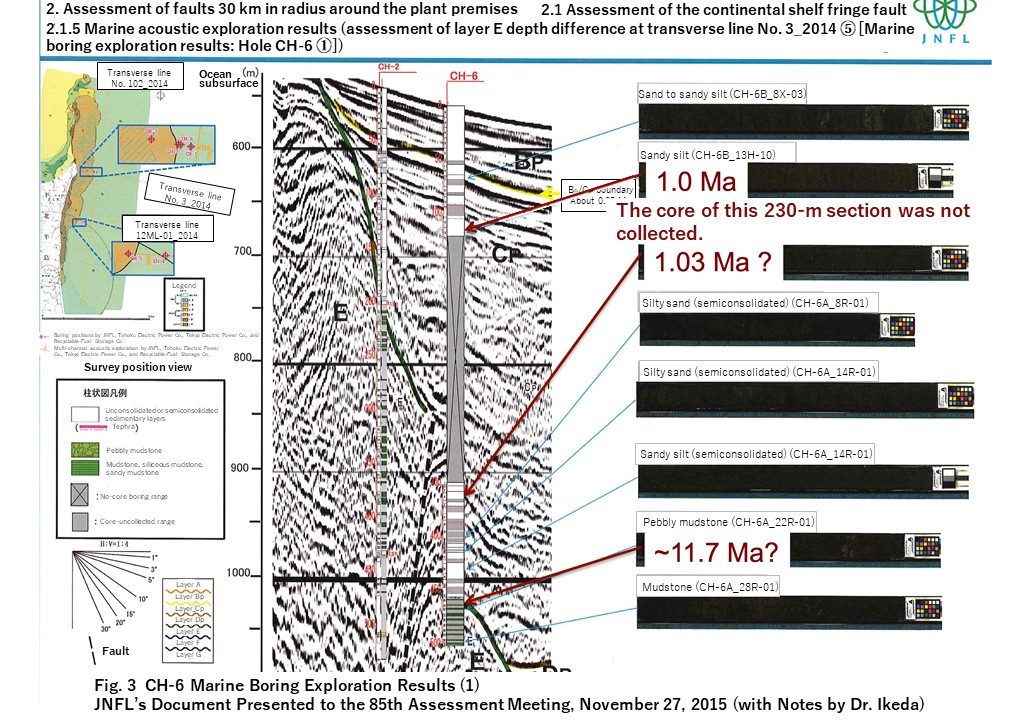
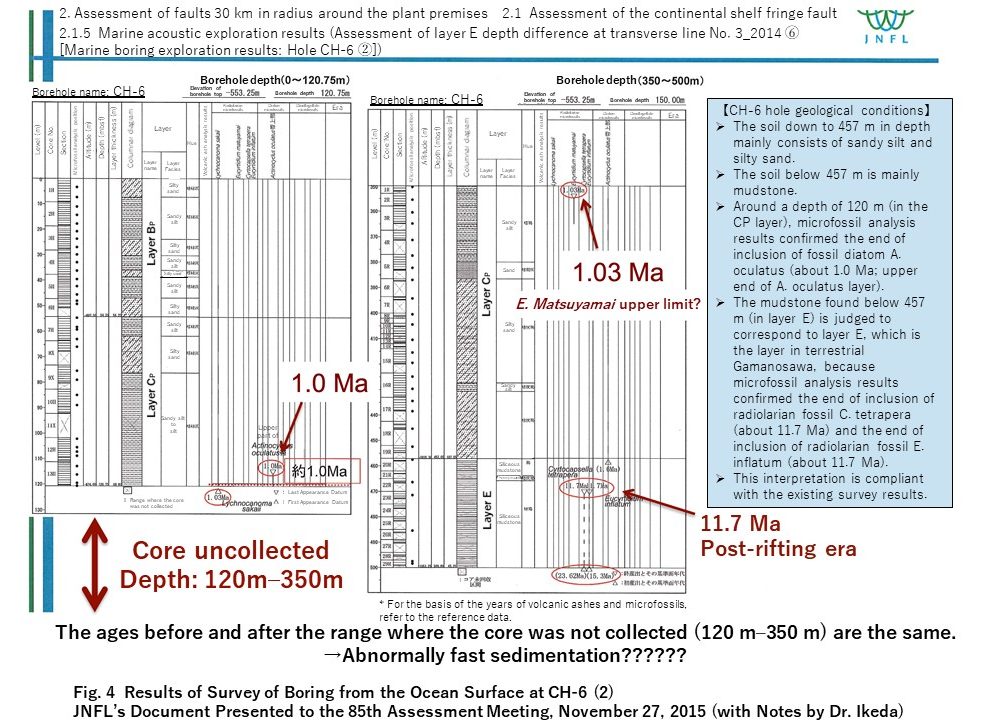 The CH-6 columnar core illustration in Fig. 3 includes a large section with a cross mark on the gray background, which indicates a range where no core was obtained. This range is located on the line extended from the upper end of layer E; therefore, it should have been required to closely examine the layer conditions, e.g., whether layer E exists here or not. However, the cross mark on the gray background means that, from the beginning, the boring was conducted with no intention of sampling the core there. Dr. Ikeda writes that the core of the 230-m range was not obtained. Further, in Fig. 4, Dr. Ikeda notes that the layer ages are almost the same before and after the range from which the boring did not result in a core being obtained the (120 m to 350 m in depth), which suggests that sedimentation was abnormally fast. Dr. Ikeda raises a critical question about the data, in which the age at the upper end of the no-core range is 1.0 Ma (one million years ago) while the age at the lower end is almost the same 1.03 Ma (one million and thirty thousand years ago). This marine boring data is scientifically totally unreliable.
Activity of the continental shelf fringe fault is not denied
Based on the marine boring data obtained in this way, JNFL says that the upper end of layer E in CH-2 and the upper end of layer E in CH-6 are about 200 m different in depth, and thus there is a fault there, which is deemed to be the continental shelf fringe fault (Fig. 2). In addition, as described above, JNFL says that the fault is not active because the layer (BP) above the continental shelf fringe fault has shown no displacement and deformation.
However, as discussed previously, this is based on the marine boring data that was deemed to have been fabricated, and even the existence of the continental shelf fringe fault averred by JNFL is doubtful. The activity of the true continental shelf fringe fault, which Dr. Ikeda interprets as having produced steep slopes on the continental shelves and as having developed marine terraces, is undeniable. If the continental shelf fringe fault moves suddenly, it can produce an earthquake of magnitude 8.5. If such a gigantic earthquake were to hit the Rokkasho Reprocessing Plant (and other nuclear facilities including Higashidori Nuclear Power Plant), the facilities would have no chance of remaining intact.
In the next article of this series, I would like to introduce interlayer-slip faults, which provide the foundation for the activity of the Rokkasho fault.
■ References
Watanabe Mitsuhisa. “Marine Terrace Surface Deformation and Geomorphic Development in the Vicinity of the Rokkasho Fault,” Active Fault Research, 2016 (in Japanese). www.jstage.jst.go.jp/article/afr/2016/44/2016_1/_article/-char/ja/
Ikeda Yasutaka. “The Continental Shelf Fringe Fault off the Shimokita Peninsula: How Did the Nuclear Plant Safety Assessment Deal With the Gigantic Underground Fault?” Science Journal Kagaku, Iwanami Shoten, Publishers, June 2012 (in Japanese).
Ikeda Yasutaka. “Review of the Marine Active Fault Survey Data by Japan Nuclear Fuel Limited (November 27, 2015),” April 16, 2016 (in Japanese).
Japan Nuclear Fuel Ltd. “Document 1-1 for the 85th Assessment Meeting for Compliance with the New Regulatory Standards,” November 27, 2015 (in Japanese). www.da.nra.go.jp/detail/NRA022002548